Something big is happening in American aviation, and it is happening fast.
In March 2026, the US Transportation Secretary stood before the country and announced a new federal program to put electric aircraft into real commercial service. Eight projects were chosen across 26 states, born from a White House executive order, with operations expected by this summer.1
The Secretary said the program will “RADICALLY CHANGE the way people and products move.”2
Washington does not talk like that about science projects. The government has decided electric aviation is happening now, not someday.
Wall Street’s most famous investors got the message. Cathie Wood’s ARK Invest has poured tens of millions into the sector’s best-known names this year, and Ken Griffin’s Citadel raised one of its positions by 245% in a single quarter.3
But here is what most investors are missing.
The famous names soaking up all that money share one uncomfortable problem. They have never flown a single paying airline passenger.
They are burning billions chasing certification. Even ARK has started trimming pre-revenue positions in favor of companies with real operations.4
So ask the obvious question. When a new industry arrives, who actually wins?
History says it is rarely the companies with the flashiest prototypes. It is the ones already flying.
Now consider what Palantir did. The $300+ billion AI powerhouse that builds systems for the Pentagon does not hand out partnerships lightly, and it certainly does not accept stock instead of cash from just anyone.
Yet Palantir did exactly that with one small aviation company. It took equity as payment, put the architect of its aviation strategy on the company’s board, and featured the company on stage at its own AI conference.5
That company is Surf Air Mobility (NYSE:SRFM).
While the air-taxi hopefuls burn cash on prototypes, Surf Air Mobility (NYSE:SRFM) already operates one of the largest commuter airlines in America. Roughly 300,000 passengers a year, and $109 million in revenue over the last twelve months.6
And together with Palantir, it built something the entire industry needs. An AI operating system called SurfOS, tested and proven on its own airline first.7
Now the number that should stop you cold.
The entire company carries a market cap of roughly $82 million.8 Wall Street values this business at less than one single year of its own revenue, while the pre-revenue names command valuations in the billions.
And the electric aviation story? Surf Air’s electric aircraft partner, BETA Technologies, was selected in seven of the eight winning eIPP federal launch programs, more than any other electric aircraft maker in the country.9
Surf Air Mobility (NYSE:SRFM) did not just pick a partner. It picked the one the government picked most.
Then came the last week of June, when everything accelerated at once. In seven days, one of the leading names in private aviation became SurfOS’s first enterprise customer,10 an electric aircraft lifted off over Hawaii with Hawaiian Airlines supporting the program,11 Palantir committed even more of its own engineers to the rollout,12 and the company cut its convertible debt principal by 64%.13
Four major announcements. Seven days. One company.
The government is in. The smart money is circling the sector. Palantir already chose.

The Airline Most Investors Have Never Heard Of Is Already One of the Largest in Regional America
Before we get to the software, the electric aircraft, and the Palantir story, let us be clear about what Surf Air Mobility (NYSE:SRFM) already is today.
This is not a pitch deck with a five-year runway. This is a working airline with more than a decade of operating history.
Over the last twelve months, the company generated $109 million in total revenue, flew 298,000 scheduled passengers, and completed 59,000 scheduled departures. That works out to about 161 flights every single day.

The company flies under the Southern Airways and Mokulele Airlines brands with a fleet of 39 aircraft. It holds interline agreements with American, United, Hawaiian, Alaska, and Japan Airlines, connecting it to partner networks that carry roughly 435 million passengers a year.
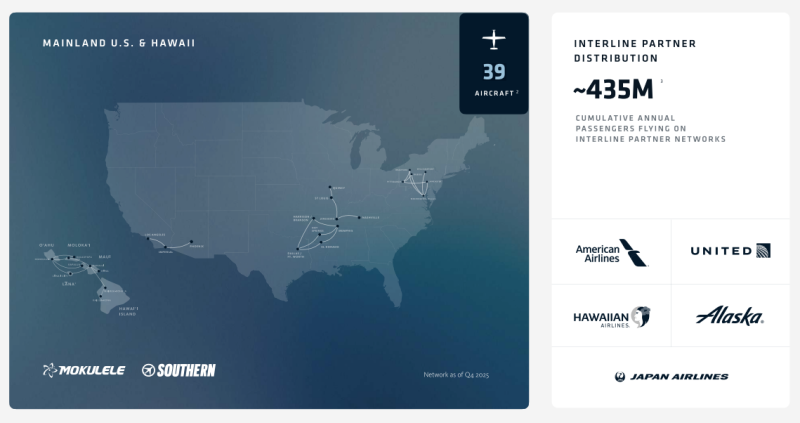
On top of the scheduled airline, Surf Air Mobility (NYSE:SRFM) runs a global on-demand private charter business. That division just posted its highest revenue and highest gross margin quarter since inception, with charter revenue up 77% year over year.14

The company also reported first quarter 2026 revenue of $25.6 million, at the high end of guidance, and beat its Adjusted EBITDA guidance. Management then improved its full-year 2026 Adjusted EBITDA guidance by roughly 40% while holding revenue guidance of $128 to $138 million, which represents 20% to 30% growth.15
For 2025, the company achieved its stated goal of profitable airline operations, defined as positive Adjusted EBITDA in airline operations.16
An operating airline. Recurring federal revenue. A charter arm growing 77%. That is the foundation everything else is built on.
Press Releases
- Surf Air Mobility Signs OperatorOS Contract with Clipper Aviation
- Surf Air Mobility Adds New OperatorOS Customer and Former Head of Asia at Palantir as New President of SurfOS
- Surf Air Mobility Selected as Participating Airspace User in FAA’s SMART Program
- Surf Air Mobility Signs OperatorOS Contract with SkyDance Air
- Surf Air Mobility Appoints Barrett Brown as President of SurfOS
The Balance Sheet Is Being Strengthened in Plain Sight
Every turnaround story has a chapter about debt, and this one is no different. What matters is the direction, and the direction here is unmistakable.
In November 2025, Surf Air Mobility (NYSE:SRFM) closed a $100 million strategic transaction that retired its most expensive debt, funded the commercial launch of SurfOS, and brought Palantir directly onto the shareholder register through $6 million of equity issued as prepayment for software services.
Read that again. Palantir accepted stock instead of cash.
The co-founder put $10 million of his own money back in alongside an institutional investor in the same deal.17 Then, on July 1, 2026, the company went further.
It refinanced its senior secured convertible note, cutting the principal by 64%, from about $47 million to $16.9 million, and shifting $30 million into a non-convertible term note. Monthly payments dropped by up to half, and subsidiaries secured a new $21.6 million aircraft-backed loan to boost liquidity.18
Less convertible debt means less dilution for shareholders. Lower payments mean more runway for the growth story.
To be clear, Surf Air Mobility (NYSE:SRFM) still carries debt and still posts consolidated losses as it invests in growth. But the capital structure that was once a risk is being rebuilt piece by piece, in public, with Palantir’s name on the cap table.
SurfOS: The Amazon Playbook, Rewritten for Aviation
Twenty years ago, Amazon made a decision that confused almost everyone. It took the internal software it had built to run its own stores and started renting it to other companies, even competitors.
That side project became Amazon Web Services. Today it powers much of the internet and generates the majority of Amazon’s profits.
The lesson: the tools a company builds to run its own operations could become worth more than the operations themselves. But the play only works if you actually run the operations first.
That is exactly what Surf Air Mobility (NYSE:SRFM) has done in regional aviation.
First, Understand the Problem
Private aviation and regional air mobility together represent a market worth tens of billions of dollars, and is growing. And much of it still runs on phone calls and spreadsheets.
Charter brokers spend hours hunting for a single available plane. Operators schedule crews with no view of fleet-wide data. Aircraft owners have almost no idea how their million-dollar assets are performing.
There is no unified platform tying it together. It’s e-commerce before Amazon.
Nobody understands that chaos better than Surf Air Mobility (NYSE:SRFM). For over a decade its people have lived inside these exact problems, on real routes, with real weather, real crews, and real customers.
What SurfOS Actually Is
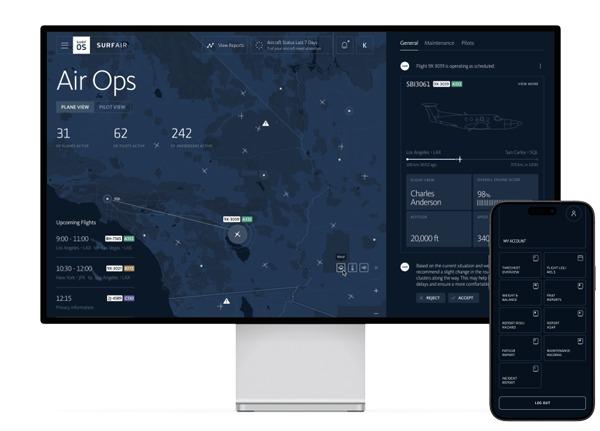
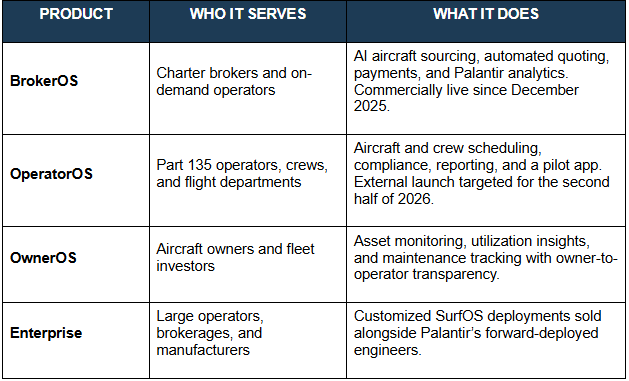
Surf Air Mobility (NYSE:SRFM) built SurfOS as the all-in-one, AI-enabled operating system for private aviation and air mobility, powered by Palantir’s Foundry and AIP platforms.
The company holds an exclusive agreement with Palantir covering the configuration and sale of this software to the Part 135 regional air mobility market. Within that market, no competitor can offer this Palantir-powered platform.19
Management estimates the products and services SurfOS targets represent a $156 billion global opportunity across charter aviation, scheduled regional service, and the small-aircraft maintenance aftermarket.20
The Numbers That Prove It Works
Here is the advantage no aviation software startup can copy. Surf Air Mobility (NYSE:SRFM) tested SurfOS on its own airline and its own charter desk before selling it to anyone.
The results, comparing the first quarter of 2026 against the same quarter a year earlier inside its own sales team: top brokers using BrokerOS closed 32% more bookings, quote-to-close times improved 57%, and 40% more payments were processed on-platform.
AI agents now handle real jobs across the business. One agent optimizes how the company buys fuel. Others handle pricing recommendations, crew scheduling, aircraft sourcing, and maintenance recovery.21
The people running these businesses do not sound like people reading a script. The president of the charter division calls BrokerOS “the biggest step change that I’ve seen within private aviation software.”22
The president of airlines puts it even more simply: “SurfOS is a fundamental shift on how this airline operates.” Eighteen months ago his teams spent their days fixing yesterday’s problems. Today they plan tomorrow’s.
▶ WATCH: Inside BrokerOS: how SurfOS transformed the private charter business
▶ WATCH: Inside the airline: how SurfOS changed daily operations
Management said the results are already showing up in the numbers. In the CEO’s words, the first quarter efficiency gains are “a clear indication of the value that SurfOS and our partnership with Palantir delivers.”
Amazon proved its software on its own stores first. Surf Air Mobility (NYSE:SRFM) proved its software on its own airline. And then the first outside customer arrived.
Wheels Up Just Became Customer Number One
On June 25, 2026, Wheels Up Experience (NYSE:UP), one of the largest private aviation companies in the world, signed on as the launch customer for Enterprise BrokerOS.
This is not a pilot program or a handshake. It is an agreement with an initial two-year term plus an option for a third, expected to deliver up to $12 million in subscription fees.
Think about what that means. A major public aviation company examined its options and chose to run its charter business on software built by Surf Air Mobility (NYSE:SRFM).
Wheels Up’s CEO described the deal as “technology as a competitive advantage in the marketplace, not a back-office function.”
And Palantir’s Global Head of Commercial framed it as proof that the operator’s expertise translates into software others will pay for.
For Wheels Up, the deployment replaces multiple legacy software platforms across its charter workflow. In other words, the industry’s old plumbing is being ripped out, and SurfOS is what goes in its place.
At Jefferies’ aerospace summit in early June, management set a 2026 goal of landing its first multi-year, multi-million dollar enterprise contract. Seventeen days later, Wheels Up signed.
Companies that hit their stated targets within weeks of stating them are rare at any size. At a $82 million market cap, they almost never stay unnoticed for long.
Palantir Is Not Just a Partner. It Keeps Doubling Down.
Plenty of small companies claim big-name partnerships. What makes the Surf Air Mobility (NYSE:SRFM) relationship different is that Palantir keeps its commitment in public.
Step one: money. In November 2025, Palantir accepted $6 million in equity instead of cash as prepayment for software services, making it one of the company’s largest outside shareholders.
Step two: people. Shawn Pelsinger, who spent ten years leading corporate development at Palantir and personally built the Surf Air relationship, joined the board of directors.23 In July 2026, he will become Chairman of the Board.24
Step three: the spotlight. On June 4, 2026, Palantir hosted Surf Air’s co-founder at AIPCon, its flagship AI conference, to demo BrokerOS live.25
You can watch that session yourself, published on Palantir’s own channel.
▶ WATCH: Surf Air at Palantir’s AIPCon 10: building the operating system for air mobility
Step four: more engineers. On June 29, Palantir announced an expanded partnership with Surf Air Mobility (NYSE:SRFM), committing additional engineering and go-to-market resources to accelerate OperatorOS, OwnerOS, and the enterprise products.
Palantir issued that press release itself, about a $82 million company. Read the sequence again: equity, board seat, main stage, more engineers.
Wall Street analysts noticed. Alliance Global Partners called the Palantir relationship “validation” of the company’s vision and “a differentiator” when it initiated coverage with a Buy rating.26
When a $300+ billion AI company keeps raising its bet on Surf Air Mobility (NYSE:SRFM), maybe the market cap is the thing that is wrong.
Hawaii Is Where Electric Aviation Gets Real First. And This Company Owns the Launchpad.
Through its Mokulele Airlines subsidiary, Surf Air Mobility (NYSE:SRFM) operates the largest commuter airline in Hawaii by scheduled departures. Nine airports, ten routes, roughly 229,000 passengers a year, and about 102 departures every day.
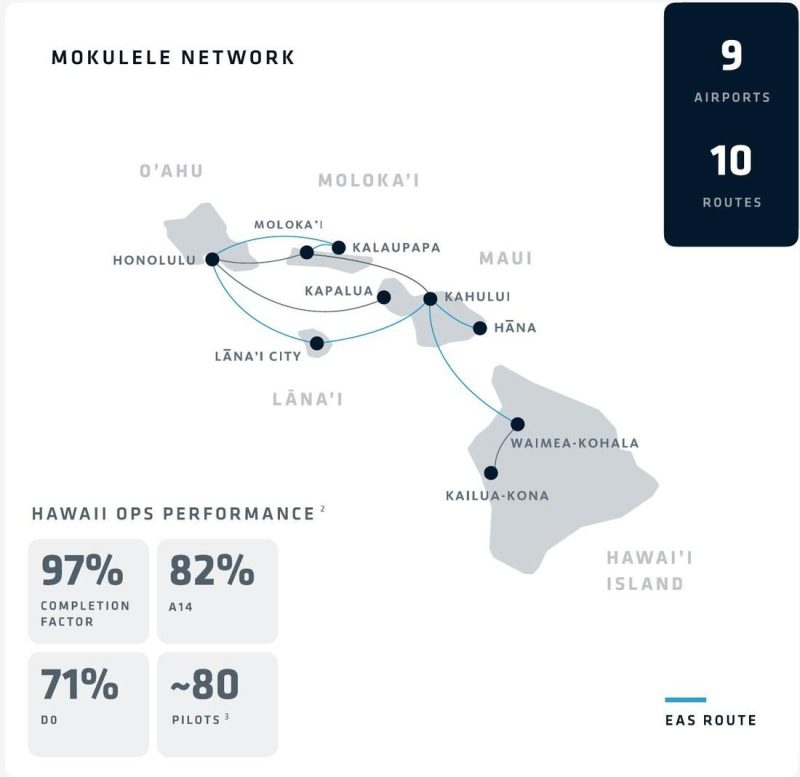
The magic number is 56. That is the average flight length in miles across the Hawaii network.
The first generation of commercial electric aircraft is built for exactly these routes. Short, frequent, point to point.
In March 2026, the company signed a strategic partnership with BETA Technologies, placing a firm order for 25 all-electric ALIA aircraft with options for up to 75 more, and becoming BETA’s designated launch operator for commercial electric passenger service.27
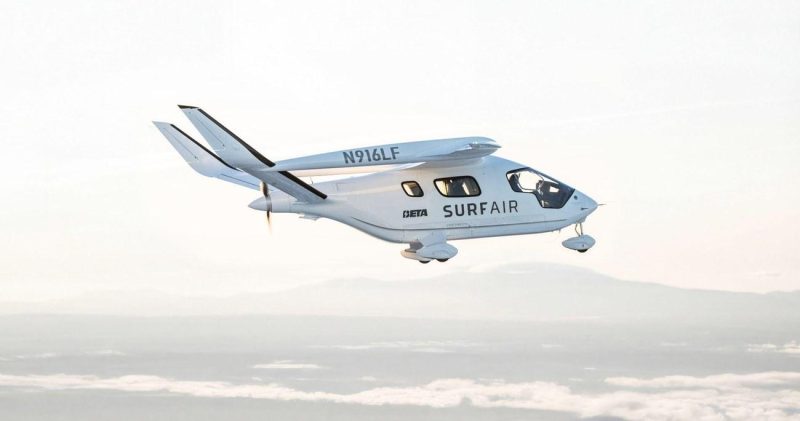
The economics are easy to understand. Management notes that a Cessna Caravan goes down for scheduled maintenance about 24 times a year, while the electric aircraft needs it about twice, on top of an estimated roughly 30% lower operating costs from fuel and maintenance.
Fewer days in the shop means more days earning revenue. That is the whole thesis in one sentence.
And this is no longer a promise on a slide. On June 26, 2026, BETA’s electric aircraft began a weeks long demonstration campaign across Hawaii, with Hawaiian Airlines hosting the launch and supporting route planning and community engagement.
Picture the moment. An aircraft with no jet engine roar lifting off near Honolulu, while the largest carrier in the islands lends its facilities and its name, and Surf Air Mobility (NYSE:SRFM) supplies the routes, the crews, and the software underneath it all.
Remember the White House program from the top of this page? Surf Air Mobility (NYSE:SRFM) partnered with the Hawaii Department of Transportation and BETA on an application to that federal initiative,28 and BETA went on to be selected in seven of the eight winning programs nationwide, more than any other electric aircraft maker.
The company is investing about $22.4 million in its Hawaii operations through the end of 2026, including new aircraft from Textron and an expansion that makes Honolulu to Molokai the most frequently flown route of any US airline.29
It also plans to become BETA’s exclusive factory-authorized service center in Hawaii once certified, adding a maintenance revenue stream on top of flight operations.
Every piece is in place. The routes, the aircraft order, the federal tailwind, the state partnership, and a major airline lending support.
7 Reasons
Surf Air Mobility Inc. (NYSE:SRFM) Deserves a Spot on Your Radar
1
Real revenue, real passengers, real operations. $109 million in LTM revenue, 298,000 passengers, 59,000 departures. This is an operating business, not a science project.
2
The software is already selling. BrokerOS has been commercially live since December 2025, and Wheels Up signed a contract worth up to $12 million.
3
A Palantir relationship that keeps deepening. Equity ownership, a board chairman from Palantir’s ranks, a main-stage AIPCon feature, and a June 2026 expansion with Palantir adding more engineers.
4
Proven internal results. 32% more bookings closed, 57% faster quote-to-close, 40% more on-platform payments, comparing Q1 2026 to Q1 2025 inside the company’s own sales team.
5
First mover in electric aviation with the government’s favorite partner. 25 firm BETA aircraft orders plus 75 options, demonstration flights already underway in Hawaii, and a partner selected in seven of eight federal launch programs.
6
A balance sheet getting stronger every quarter. Convertible note principal cut 64% in July 2026, monthly payments cut by up to half, and $21.6 million in new aircraft-backed liquidity.
7
A massive market with almost no modern software. McKinsey projects regional air mobility reaching $75 to $115 billion by 2035,30 NASA calls it transformational for American transportation,31 and management sizes the full SurfOS opportunity at $156 billion.
Any one of these would make a $82 million company interesting. Surf Air Mobility (NYSE:SRFM) has all seven at once.
One of These Companies Is Not Like the Others
The air mobility sector has attracted billions of investor dollars over five years. Most of it went to companies that have never carried a paying passenger.
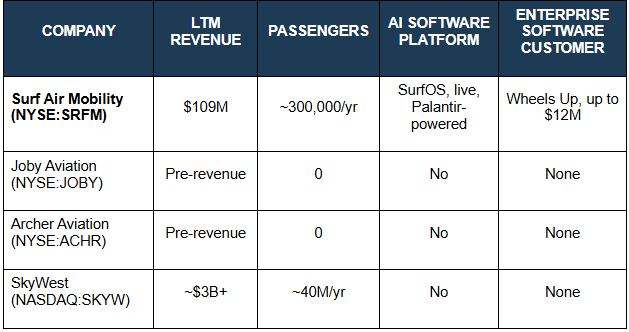
The point is not that the competitors are bad companies. Joby just landed test flights at JFK, Archer completed a major FAA certification phase, and the industry is clearly arriving.
The sector is even consolidating around operators. Joby recently acquired Blade’s passenger business to get real routes and real customers.32
But notice the pattern. The pre-revenue names trade in the billions while Surf Air Mobility (NYSE:SRFM) trades at less than one year of its own revenue, and it is the only one on the list with revenue, passengers, live AI software, and a paying enterprise customer.
The Analysts Are Arriving.
Cathie Wood’s ARK Invest and Ken Griffin’s Citadel have been pouring money into regional electric aviation all year. That tells you the industry is real.
But watch what happened next. In June, ARK dumped $12.7 million of one pre-revenue name, a move coverage described as rotating away from pre-revenue stories toward companies generating actual operating results.
The smartest money in the world is learning, in real time, that in this sector operations beat prototypes. And there is exactly one small-cap in the space with 300,000 passengers, $109 million in revenue, and Palantir software: Surf Air Mobility (NYSE:SRFM).
To be clear, neither ARK nor Citadel has disclosed a position in the company. The point is simpler than that. The biggest names in investing have decided this industry is worth billions, and their own hard lessons keep pointing toward operators with real revenue.
Inside Surf Air Mobility (NYSE:SRFM) itself, the ownership signals point the same direction. Palantir is one of the largest outside shareholders, the co-founder reinvested $10 million, and institutional holders include names like Vanguard and BlackRock.33
Professional analysts are arriving too. H.C. Wainwright initiated coverage with a Buy rating and a $12 price target, citing the revamped management team and the company’s distinct path in electric aviation.34
Northland Securities initiated at Outperform with a $5 target in May 2026.35 Alliance Global Partners initiated with a Buy and a $2.75 target the same month, singling out the Palantir partnership.
For context, the stock has recently traded near $1. These targets were also all published before the late-June wave of Wheels Up, Palantir, and Hawaii announcements.
Stonegate Capital Partners, in company-sponsored research, noted the stock trades at 1.3x estimated 2027 revenue versus 2.4x for comparable companies.36
Even the aviation trade press is paying attention. Aviation Week, the industry’s most respected publication, just profiled how the company is commercializing software originally built to run its own airline.37
Government programs, famous investors, Buy ratings, and trade press coverage, all converging on one corner of aviation. And Surf Air Mobility (NYSE:SRFM) sits at the center of it with a market cap smaller than its own annual revenue.
The Team That Has Built This Before

 Deanna WhiteCEO
 Oliver ReevesCFO
 Sudhin ShahaniCo-Founder
 Shawn Pelsingerincoming Chairman of the Board
The Story Wall Street Might Be Missing
Let us come back to where this all connects.
Amazon built software to run its own stores, then sold that software to the world, and the software became the fortune. The store was just the proof.
Surf Air Mobility (NYSE:SRFM) built software to run its own airline. The airline flew 300,000 passengers and proved the software works. Now Wheels Up is paying for it, Palantir is accelerating it, and OperatorOS launches to the industry this year.
Add the electric aviation launchpad in Hawaii, the federal program tailwind, the BETA aircraft order, and a balance sheet that just got dramatically cleaner.
Then hold all of that against a market cap of roughly $82 million, less than one year of the company’s own revenue.
To be fair, this is a small company that still posts consolidated losses, and small caps carry real risk and real volatility. Nobody should pretend otherwise, and every investor should read the filings and decide for themselves.
But the facts on the page are simple. The government has spotlit the industry. The famous money moved in. Palantir picked its partner years ago and keeps doubling down.
The last week of June showed what happens when all of it converges. Four major announcements in seven days, and a market that is only beginning to connect the dots on Surf Air Mobility (NYSE:SRFM).
The planes are flying. The software is selling. The catalysts are stacking.
And a final reminder to always do your own research.
Want to Stay Ahead of Every Surf Air Mobility (NYSE:SRFM) Development?
Subscribe to receive press releases, investor presentations, and earnings updates the moment they drop.
Subscribe here and be the first to know.