One Company Is Building the Same Infrastructure Layer for Regional Aviation — With Palantir Powering the Engine.
Most investors never heard of Shopify before it went public in 2015.
But every time a merchant launched an online store, processed an order, or managed inventory at scale, Shopify was running the infrastructure behind the scenes.
The company did not own a single warehouse. It did not sell a single product. It built the software infrastructure that hundreds of thousands of merchants depended on to run their entire businesses. It went public at a market cap of roughly $1.3 billion. Today that market cap sits above $120 billion. That is a 90x expansion — built entirely on owning the operating layer.
That is the model that quietly mints fortunes in infrastructure technology.
You do not have to own the most stores.
You have to own the operating layer that every store — or in this case, every operator — depends on.
Shopify proved it in e-commerce. Palantir proved it in defense intelligence. And right now, one publicly traded company is positioning itself to do the exact same thing for regional aviation.
Regional aviation today looks exactly like e-commerce did before Shopify came along.
Fragmented. Broker dependent. Running on legacy systems. Operators making scheduling decisions on spreadsheets. Charter brokers spend hours sourcing aircraft that should take minutes. Aircraft owners with almost no visibility into how their assets are being used.
The industry is flying millions of passengers every year on infrastructure that was never designed for modern data.
There is no unified platform tying any of it together.
That is the gap Surf Air Mobility Inc. (NYSE:SRFM) was built to fill.
Not just as an airline.
As a platform company that operates one of the largest regional airline networks in the United States as the real world proving ground for its own technology.
While competitors are still burning cash on prototypes and chasing certifications, Surf Air Mobility (NYSE:SRFM) is already flying, already profitable in airline operations, and already deploying the AI software that could define how an entire industry runs for the next two decades.
This is the setup Wall Street has not fully priced in yet.
And windows like this do not stay open for long.
The Airline Most Investors Have Never Heard of Is Already Running One of the Biggest Regional Networks in America
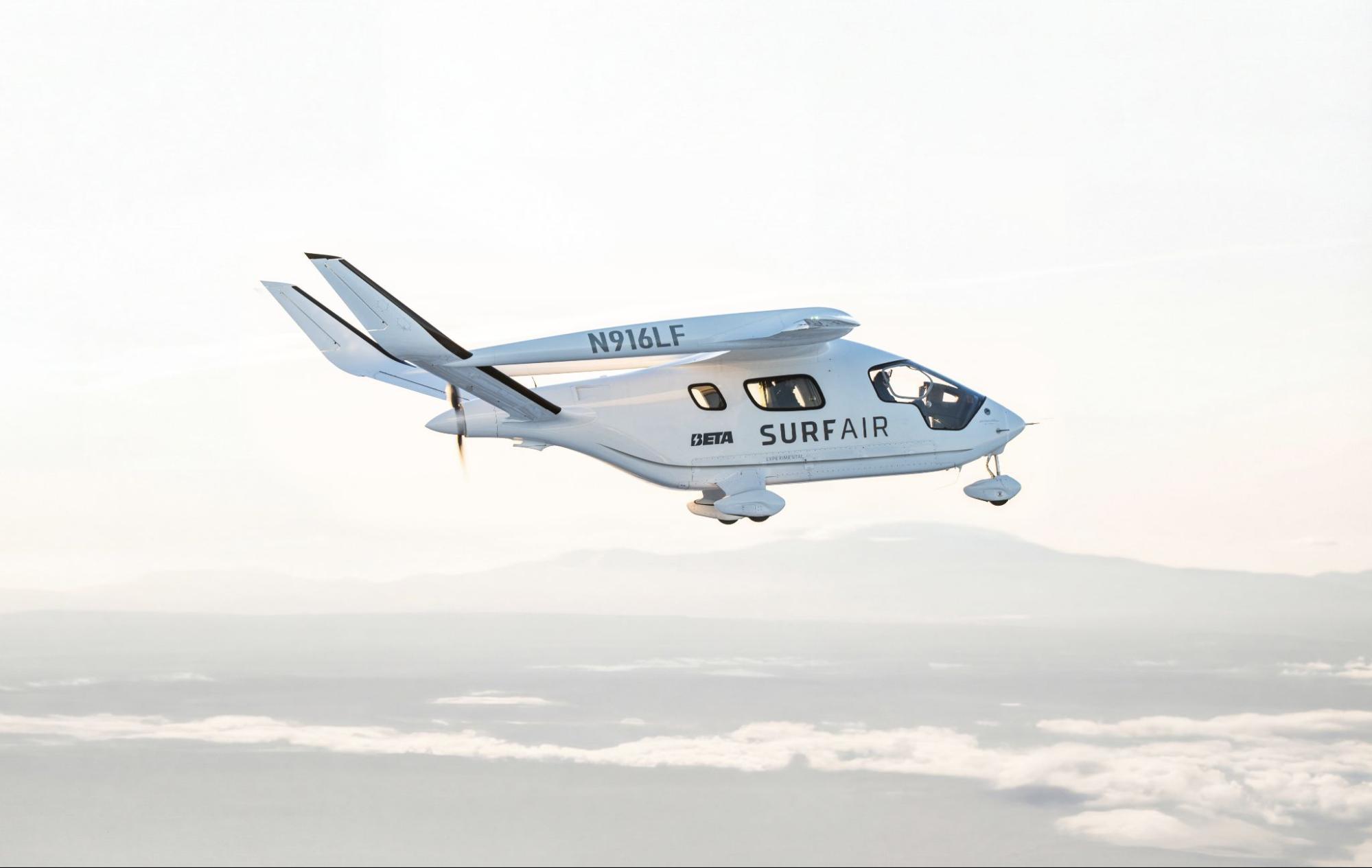
Before we get to the software and the electrification, let us be clear about what Surf Air Mobility Inc. (NYSE:SRFM) already is today.
This is not a pre-revenue startup. This is not a pitch deck with a five-year runway to commercialization.
This is an operating airline that flew 300,000 passengers in 2025, executed over 60,000 scheduled departures, and generated over $106 million in revenue.1

The company operates under the Southern Airways and Mokulele Airlines brands with a fleet of 39 Cessna Caravan aircraft and interline agreements with American, United, Hawaiian, Alaska, and Japan Airlines.
Those five interline partnerships help connect Surf Air Mobility (NYSE:SRFM) to a combined annual passenger base of approximately 435 million travelers on partner networks.
Q4 2025 marked the third consecutive quarter of positive Adjusted EBITDA in airline operations, and the airline operations achieved full year 2025 positive Adjusted EBITDA. Revenue of $26.4 million, bringing its 2025 FY revenue to $106.6 million.2
The growth story is just starting.
A $100 Million Strategic Transaction Just Changed Everything About This Balance Sheet
In November 2025, Surf Air Mobility Inc. (NYSE:SRFM) closed a $100 million strategic transaction that did three things at once.
It funded the commercial launch of SurfOS.
It retired the most expensive debt on the balance sheet.
And it brought Palantir Technologies directly onto the cap table as an equity partner.
Here is exactly how the capital was structured:3
-
-
- $74 million zero coupon convertible note to High Trail Capital, used to retire $51 million owed to Comvest Partners and $8 million owed to Partners For Growth.
- $5.5 million in annual cash interest eliminated from the balance sheet as a direct result of the refinancing.
- $20 million in new common equity purchased at market price by an institutional investor and co-founder Sudhin Shahani, with $10 million each. Co-founder money going back in.
- $6 million in equity issued directly to Palantir Technologies as prepayment for software and services. Palantir accepted equity instead of cash. That is not a normal vendor relationship.
- $26 million specifically earmarked for SurfOS development and commercial rollout in 2026.
-
The result?
At the time of the transaction Surf Air Mobility (NYSE:SRFM) reduced consolidated net debt by 37.3% in under 12 months. From $139.1 million down to $87.2 million.
The balance sheet that was the company’s biggest risk is no longer the story.
The growth catalyst is.
SurfOS Is the Operating System Regional Aviation Has Been Waiting For
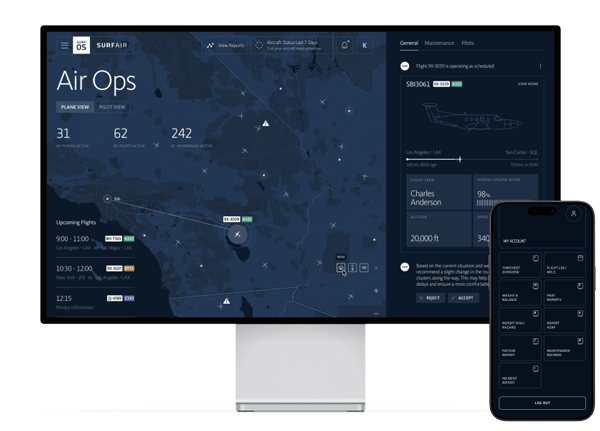
First, Understand the Problem
The private aviation and regional air mobility market is worth tens of billions of dollars.
And it is held together with phone calls and spreadsheets.
Data lives in silos across dozens of incompatible legacy systems. Charter brokers spend hours manually sourcing aircraft. Operators schedule crews without visibility into fleet-wide performance data. Aircraft owners have almost no insight into how their assets are performing.
This is not a niche inconvenience.
This is a structural inefficiency inside a multi-billion dollar industry, and no one has built a unified platform to solve it. Until now.
What SurfOS Actually Is
Surf Air Mobility Inc. (NYSE:SRFM) built SurfOS as the all-in-one, AI-enabled operating system for the private aviation and air mobility industries.
And it’s powered by Palantir’s Foundry and AIP platforms.
Surf Air Mobility (NYSE:SRFM) holds an exclusive five year agreement with Palantir for the configuration and sale of this software to the Part 135 regional aviation market.
No other company can offer this platform. That exclusivity is a structural moat.
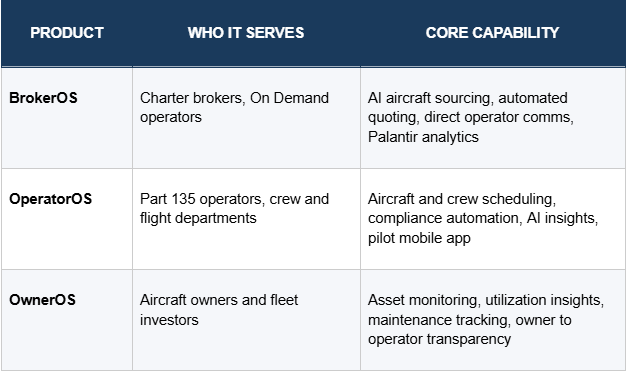
The platform has three flagship products, each targeting a different participant in the regional aviation ecosystem
The Numbers That Prove It Works
Here is the advantage no aviation software startup can match.
Surf Air Mobility Inc. (NYSE:SRFM) tested SurfOS on its own operations before offering it to the market.
Real flights. Real brokers. Real operators. Real data.
To date, the company has signed over 17 letters of intent and beta agreements with third party brokers and operators.4
The commercial rollout is targeted for 2026, backed by $26 million in dedicated funding for SurfOS.5
The 440-plus operator relationships built since inception are the initial distribution channel.
The product is proving itself. The customers are beginning to line up. The only thing left is launch.
Palantir Is Not Just a Partner. They Are One of the Largest External Shareholders.
Palantir Technologies (NASDAQ:PLTR) is the $374 billion AI company that built battlefield intelligence systems for the Pentagon and helped track global disease outbreaks for the CDC.
Palantir is one of the largest non-insider shareholders of Surf Air Mobility (NYSE:SRFM).
They accepted equity instead of cash as prepayment for software services.
And in October 2025, Surf Air Mobility Inc. (NYSE:SRFM) appointed Shawn Pelsinger to its board of directors.7
Pelsinger spent ten years as Global Head of Corporate Development and Senior Counsel at Palantir, where he personally helped build the Surf Air relationship.
He also helped architect Skywise, the Palantir and Airbus partnership that became the data backbone for commercial aircraft maintenance globally.
When the architect of the Palantir aviation playbook joins the board, that seems like a good sign.
Hawaii Is Not Just a Route Network. It Is the Blueprint for the Electric Aviation Future.
The most important thing about Surf Air Mobility‘s Hawaii operations is not what they are today.
It is what they prove is possible tomorrow.
Through its Mokulele Airlines subsidiary, Surf Air Mobility (NYSE:SRFM) operates the largest commuter airline in Hawaii by scheduled departures.
9 airports. 10 routes. Over 224,000 passengers per year. Approximately 36,000 departures. A 96%+ controllable completion factor.
And an average stage length of 56 miles.
That number is the main thesis.
The first generation of commercial electric aircraft are being designed for routes for this distance. Short, high frequency, point to point.
Every Mokulele flight is a data point, a proof of concept, and a future deployment opportunity for electrified aircraft.
Press Releases
- Surf Air Mobility Signs OperatorOS Contract with Clipper Aviation
- Surf Air Mobility Adds New OperatorOS Customer and Former Head of Asia at Palantir as New President of SurfOS
- Surf Air Mobility Selected as Participating Airspace User in FAA’s SMART Program
- Surf Air Mobility Signs OperatorOS Contract with SkyDance Air
- Surf Air Mobility Appoints Barrett Brown as President of SurfOS
A Bigger Electric Aviation Partnership Is Taking Shape
On March 12, 2026, Surf Air Mobility Inc. (NYSE:SRFM) announced a strategic partnership with BETA Technologies to help launch commercial electric aircraft service, starting in Hawaii.8
The deal includes a firm order for 25 electric aircraft, with options for up to 75 more. Surf Air also plans to support cargo operations, future passenger service, charging infrastructure, and aircraft maintenance as commercial electric aviation begins to roll out.
This is not about a pilot program. It is a broader commercial partnership designed to put Surf Air Mobility closer to the real-world launch of electric flight.
BETA’s ALIA aircraft has already flown over 100,000 nautical miles in real world operations. The initial eIPP mission plan involves cargo operations between existing Mokulele route pairs, building the operational safety record needed before passenger service begins.
The infrastructure, the routes, the airport access, and the operating expertise are all in place today.10
And that future is no longer hypothetical. Surf Air Mobility (NYSE:SRFM) has locked in a firm order for 25 of BETA Technologies’ all‑electric ALIA CTOL aircraft, plus options for up to 75 more, in a strategic deal to launch the first commercial electric passenger service in Hawaii.11
A $22 Million Investment in the Launch Market for Advanced Air Mobility
To prepare Hawaii as the showcase market for next generation aircraft, Surf Air Mobility Inc. (NYSE:SRFM) is investing approximately $22.4 million in Mokulele operations through the end of 2026.12
Among the highlights:
-
-
- Starting Q1 2026, Mokulele plans to add seven new daily roundtrips to Molokai, including five new roundtrips to Honolulu and two new roundtrips to Kahului.
- With this expansion, Mokulele will operate the most frequently flown route of any airline in the United States. The Honolulu to Molokai corridor.
- New Cessna Caravan aircraft delivered from Textron Aviation, with two additional aircraft entering service in 2026.
- Launch of the Elevate loyalty program with tiered benefits, priority service, and bonus points for frequent flyers on both Mokulele and Southern Airways.
-
BETA’s ALIA: Hawaii’s First Electric Fleet
Surf Air Mobility (NYSE:SRFM) expects to initially deploy BETA’s ALIA CTOL aircraft for cargo services under Mokulele Airlines in Hawaii, leveraging short‑haul, high‑frequency inter‑island routes as the optimal launch market for electric operations.
Following certification of BETA’s passenger‑configured ALIA aircraft, Surf Air Mobility plans to become the first Part 135 operator to commercialize electric passenger flights in Hawaii for both scheduled service and On Demand charter.
As part of the partnership, Surf Air Mobility also intends to establish BETA factory‑authorized service centers with geographic exclusivity in launch regions, beginning with an MRO facility in Hawaii that is expected to add a new, growing maintenance revenue stream alongside flight operations, once certified.
7 Reasons
Surf Air Mobility Inc. (NYSE:SRFM) Deserves a Spot on Your Radar
1
Real Revenue, Real Passengers, Real Operations. Surf Air Mobility (NYSE:SRFM) generated $106.6 million in revenue in 2025 and flew over 300,000 passengers on 60,000 flights. This is not a pre-revenue science project. It is an operating business with real unit economics.
2
Full Year Airline Profitability. Q4 2025 revenue of $26.4 million and FY 2025 revenue of $106.6 million. Their airline operations has positive Adjusted EBITDA for the full year 2025
3
SurfOS Goes to Market in 2026 With $26 Million in Dedicated Funding. The operating system for regional aviation is being proven internally and is going to market this year. They have letters of intent and software agreements already in place.
4
An Exclusive Palantir Partnership No Competitor Can Replicate. The five year exclusivity agreement gives Surf Air Mobility Inc. (NYSE:SRFM) the sole right to configure and sell this software to the Part 135 regional aviation market. Palantir is also one of the largest shareholders in the company. The architect of the Palantir aviation playbook sits on the board.
5
Surf Air’s Electric Aviation Push Just Got Bigger. Surf Air Mobility (NYSE:SRFM) and BETA Technologies announced a broader commercial partnership built around launching electric aircraft service in Hawaii, with 25 aircraft on firm order, options for 75 more, and additional upside from infrastructure and maintenance support.
6
The Balance Sheet Transformation. Net debt decreased 47% from $139 million at December 31, 2024, to $74 million at December 31, 2025.
7
A $75 Billion to $115 Billion Market. McKinsey projects the global regional air mobility market at $75 to $115 billion by 2035.13 NASA has called it transformational for American transportation. 5,000 underutilized regional airports.14 90% of Americans within 30 minutes of one. The industry seems ready for a platform solution.
While the Air Mobility Sector Burns Cash on Prototypes, One Company Is Already Flying and Building the Platform
The regional and urban air mobility space has attracted billions in capital over the past five years.
Most of it has gone to companies that have not yet carried a single paying passenger.
Surf Air Mobility Inc. (NYSE:SRFM) is operating in a different category entirely.
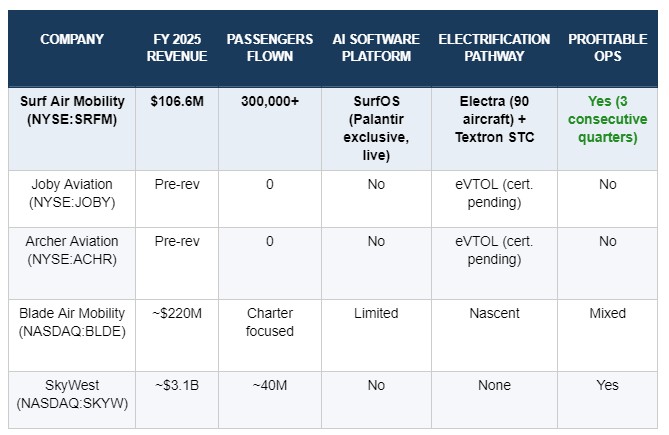
The point is not that the competitors are bad companies.
The point is that Surf Air Mobility (NYSE:SRFM) is operating in a different league of commercial reality.
It is the only company in regional aviation that is simultaneously generating real revenue, building the AI-enabled software for the industry, pursuing electrification, and trading at a fraction of the valuation its pre-revenue peers command.
The Smart Money Is Already Here. The Rest of the Market Hasn’t Caught On.
When Palantir Technologies accepts equity instead of cash as payment for software services, it sends a signal.
When the co-founder puts $10 million back into the company alongside an institutional investor, that is another signal.15
When the architect of Palantir’s aviation strategy joins the board of directors, that is a third signal.
Taken together, the shareholder picture at Surf Air Mobility Inc. (NYSE:SRFM) tells a clear story.16
Palantir Technologies (NASDAQ:PLTR) stands out as one of the company’s largest non-insider institutional shareholders.
The broader institutional base also includes well-known firms such as Vanguard, Raymond James, BlackRock, Rathbone, and Colony Group. Altogether, that mix suggests Surf Air Mobility has attracted attention from both major asset managers and sophisticated investment firms.
These are not retail speculators chasing a headline.
These are institutions.
And they’re invested.
HC Wainwright has initiated coverage of Surf Air Mobility (NYSE:SRFM) with a Buy rating.
CEO Deanna White and CFO Oliver Reeves have presented at the HC Wainwright AeroNext Conference and the Needham Industrial Tech Conference. Analyst attention is building.
When institutional money and sell-side coverage arrive at the same time on a low-float small cap, the setup tends to get interesting.
The Roadmap Is Set. The Catalysts Are Stacking. Here Is What Comes Next.
The four phase transformation plan of Surf Air Mobility Inc. (NYSE:SRFM) was not designed to produce marginal improvements to an airline.
It was designed to build a platform company that uses an airline as its most powerful competitive moat.
Here is exactly where things stand:
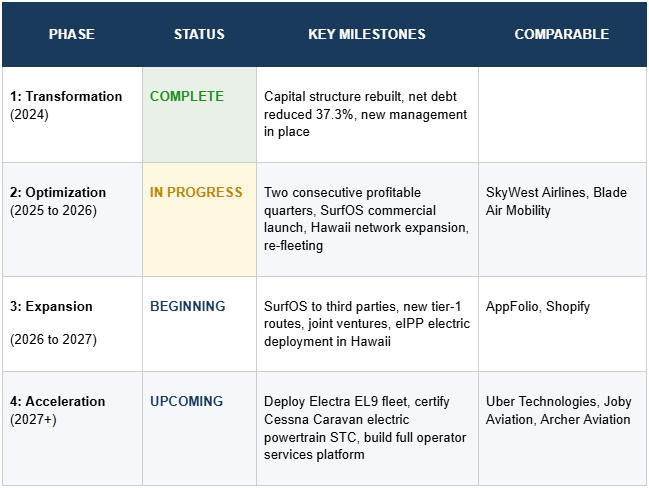
Phase 2 is executing. Phase 3 is being built in real time.
Meet the Team That Has Already Built This Before
Great technology and great timing mean nothing without a team that knows how to execute inside a regulated industry.
Defense contracts do not go to companies with good ideas. Neither do airline licenses, STC certifications, or Palantir partnerships.
They go to companies that execute.
The leadership of Surf Air Mobility (NYSE:SRFM) is not a group of first-time founders learning on the job.
 Deanna WhiteCEO and COO
 Oliver ReevesChief Financial Officer
 Sudhin ShahaniCo-Founder and Board Member
 Shawn PelsingerBoard of Directors
The Sky Is Not the Limit. The Platform Is.
Let us come back to where we started.
Shopify did not build the most glamorous business in aviation.
It built one of the most essential ones.
Every airline depended on it. Every reservation ran through it. Every gate assignment touched it. And it turned that invisible infrastructure position into a multi-billion dollar company that outlasted dozens of the airlines it served.
That is exactly the position Surf Air Mobility Inc. (NYSE:SRFM) is building toward with SurfOS for the private aviation and regional / advanced air mobility spaces.
Not the flashiest company in air mobility.
The most essential one.
The platform that regional operators could run their businesses on. The software that manages crew schedules, sources charter aircraft, gives aircraft owners real-time visibility into their assets, and ties the entire fragmented ecosystem together through Palantir’s AI infrastructure.
And here is the part that makes Surf Air Mobility (NYSE:SRFM) different from every other aviation software company:
It also operates the airline.
The real world, 300,000 passenger, 60,000 departure airline that proves SurfOS works before any third party operator has to take a risk on it.
The airline is not a distraction from the software thesis.
It is the most powerful customer reference in the industry. And it is owned by the same company selling the software.
Add in the electrification roadmap, the Hawaii deployment thesis, and the BETA electric aircraft on order, and the exclusive Palantir relationship, and you have a company sitting at the intersection of three converging trends.
AI-powered software. Electric aviation. An emerging air mobility industry.
Real planes. Real passengers. Real revenue. Real software. Real electrification roadmap. Real government partnerships.
A management team that has built this before.
That is the Surf Air Mobility Inc. (NYSE:SRFM) story.
And it is just getting started.
Want to stay ahead of every Surf Air Mobility (NYSE:SRFM) development before it hits the mainstream wire?
Subscribe to receive press releases, investor presentations, and earnings updates the moment they drop.
Subscribe here and be the first to know.