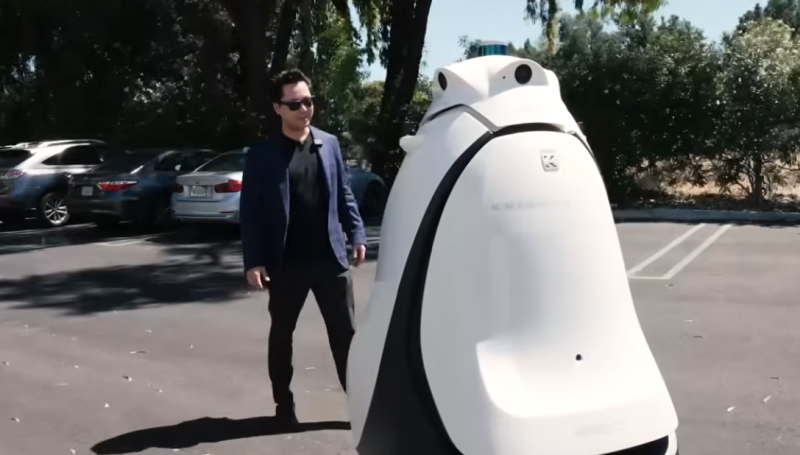
A Demonstration in the Parking Lot
The man crossing the parking lot announced that he was about to steal a car.
He got roughly two sentences into it. A five-foot, 400-pound machine turned towards him, lights running, and stated the situation: “You’re under active security monitoring.”1 David Lin, the financial interviewer staging the theft for his own camera, decided to stop.
The machine did not pursue him or summon anyone. That, according to William Santana Li, Chairman and Chief Executive Officer of Knightscope Inc., accounts for a large share of what the company actually sells. After more than 4.4 million hours of operation across the country, Mr. Li said a marked machine on site stops a substantial amount of activity before it begins, in his estimate, close to half the time.2
Knightscope, Inc. (NASDAQ: KSCP) is the security technology company building the nation’s first Autonomous Security Force from its Silicon Valley headquarters. In recent weeks, the company opened its headquarters to three interviewers who arrived from noticeably different starting points. Mr. Lin pressed on hardware, privacy, and unit economics. Cyrus Janssen, who has spent years covering business and technology in China, wanted to know what the United States was building in response. Brandon Trades, a full-time trader who once expected to join the Maryland State Police, asked how a company like this gets built at all.
Taken together, the three conversations describe an attempt to assemble something the physical security industry has never had: one company accountable for the machines, the software, the monitoring and the guards at the same time.
A Fragmented Market With No One in Charge
Mr. Li’s description of his own industry is not flattering. It is, he told Mr. Janssen, “wildly fragmented, unmanaged, and not the most technologically progressive part of our economy, and it’s ripe for disruption.”3
His reference point is the military. Beyond U.S. borders, he argues, there is a trillion-dollar budget, a single cabinet officer accountable for it, and a procurement process that eventually delivers equipment into a soldier’s hands. Domestically, he said, the Departments of Justice and Homeland Security hold no federal jurisdiction over roughly 19,000 law enforcement agencies and 8,000 private security firms. “There’s literally no one in charge.”4
He walks through the arithmetic in each of the three interviews. Roughly 1.5 million security guards and about 1 million law enforcement professionals, or 2.5 million people. Crime keeps no schedule, and no one works three shifts, so divide by four. That leaves something like 600,000 people on duty at any given moment for 332 million Americans, supported by an estimated 300,000 law enforcement vehicles and roughly 100 million cameras, of which he says about 2% are meaningfully monitored.5 He puts the annual economic cost of crime in the United States at $2.6 trillion, and the pace of violent crime at one incident every 26 seconds.6
From Ford Motor Company to a Post 9/11 Mission
Mr. Li did not arrive at this from robotics. He arrived from Detroit.
He spent a decade at Ford Motor Co., by his own account, 12 jobs in 10 years across four continents, finishing as a director of mergers and acquisitions who persuaded the board to release a quarter of a billion dollars for a roll-up in the used auto parts business. He bought 22 companies in 11 months. He was 28 years old.7
Then came September 11, 2001. “I was born in New York City; someone hit my town on 9/11,” he told Mr. Janssen. “I’m still profoundly pissed off about it.”8 The rest of the account is quieter. His mother was born in Bogotá and his father outside Shanghai, and they met in New York. “This country gave them and me an unbelievable life,” he said. “And so I feel like I have a bit of a debt to pay.”9
He is careful to disclaim any technical romance about the machines themselves. He is not a roboticist, he said, and if rubber bands and paper clips solved the problem, he would go build factories for rubber bands and paper clips.10
What the Machines Do on Patrol
Walking Mr. Lin through the hardware, Mr. Li described the K5’s job in the same two words the industry applies to a human guard: observe and report. A guard is not permitted to put hands on anyone either, he noted.11
The K5 patrols at up to three miles an hour, autonomously rather than by remote control, on a sensor package Mr. Li compares to a self-driving car. It streams and records 360-degree video at eye level, a distinction he treats as substantive, since the alternative is a ceiling camera studying the top of a person’s head. It runs thermal scans, reads several hundred license plates a minute, listens for anomalies such as breaking glass rather than for conversation, and can detect a mobile device roughly 500 feet away. A distress button on the back opens a two-way call.12
The last capability is the one the company’s argument rests on. In a sequence filmed for Mr. Janssen, a phone signal approaches a fence line before any camera has registered a person. A wall-mounted device gets a partial view. A robot is sent to look. Three independent detections converge, and the confidence that a person is present moves from a guess to near certainty, at which point the system can make an announcement and resolve the situation without waking anyone.13 Against an industry in which Mr. Li says more than 90% of alerts are false, the claim is not better cameras but fewer meaningless phone calls.
Knightscope (NASDAQ: KSCP) plans limited production in the fourth quarter of a larger machine, the K7, a four-wheeled unit that reaches 10 miles an hour over gravel and dirt. It is built for solar farms, distribution yards and airport perimeters, where installing a sensor every 500 feet is not practical. Mr. Li said the waiting list is long, and that the unit will be available only to clients buying the full service rather than a single machine to trial in a corner.14 A stationary tower, the K1, is the company’s answer to the emergency blue light call boxes on campuses and in parking structures, many of which he says lack lighting or reliable connectivity. A wearable, the H1, puts a version of the same sensing on the company’s own agents.15
On surveillance, Mr. Li’s answer is jurisdictional. The machines operate on private property with posted signage, more than 90% carry a client or police logo, and audio is not recorded unless the distress button is pressed, at which point the machine announces that it is recording.16
Why a Robotics Company Bought a Guarding Business
The line that recurs across all three interviews is not about machines. “The most powerful combination is not technology versus humans; it’s technology and humans,” Mr. Li told Mr. Trades.17 To Mr. Lin, he was more specific: “This is a tool for the security agent as opposed to let me see how many humans I can go replace.”18
Earlier this year, that position became a transaction when the company acquired a conventional guarding business. Mr. Li’s explanation is commercial. Chief Security Officers, he argues, are typically former military or law enforcement rather than technologists, and they field a steady stream of vendors carrying incompatible equipment and separate invoices. If a decade of selling them technology had not changed the industry, he told Mr. Janssen, then the offer format was wrong. Acquiring a guarding business meant selling something those buyers already know how to purchase, and then earning the standing to redesign the site from inside the contract.19
What he says he is building is a category borrowed from elsewhere. Chief Information Officers have managed service providers, single vendors accountable for an entire outcome. Physical security, he argues, never developed one.20
How Knightscope Charges for the Technology
The machines are not sold. They are subscribed to, with the asset remaining on Knightscope’s balance sheet and the fee covering hardware, software, telecommunications, data storage, training, maintenance and service parts.21 Mr. Li places the technology in a range of roughly one to twenty-five dollars an hour. An unarmed human agent, by his figures, costs about twenty-five dollars an hour, and executive protection closer to one hundred twenty-five.22
The guarding side is priced differently and staffed deliberately. Mr. Li said the acquired operation runs employee turnover near 6%, against an industry norm he puts at 100% to 400%, and attributed the gap to paying properly, providing benefits, keeping agents as W-2 employees and issuing them stock options.23
The combined business at Knightscope (NASDAQ: KSCP) now serves 434 clients across 42 states, with what Mr. Li describes as roughly 10,000 machines and agents in network.24 He has said publicly that the five largest of those clients spend about $850 million a year on security in total, a figure he uses to argue that the addressable spending inside the existing customer base is considerably larger than the revenue the company currently collects from it.25
Two Years of Rebuilding, and a Target of One Million Machines
Mr. Li spent much of the past two years reorganizing the company rather than expanding it. “The last two years I’ve been literally refounding the company,” he told Mr. Lin, describing a new board of directors, a new Chief Financial Officer, a substantially changed management team, and a consolidation of facilities.26 He told Brandon Trades that the company is in better shape now than at any point in its 13 years.27
The target he sets is specific. He wants a million machines in networks across the country, able to see, hear, speak, and cooperate around the clock, supporting the officers and guards already on shift.28 The company he describes building around them is structurally closer to a defense contractor than to a technology vendor, with the capabilities pointed at domestic ground rather than foreign battlefields. He believes that supports a $30 billion company, a projection he offers as his own rather than as a forecast anyone else has validated.29
Asked by Mr. Janssen what he would tell a prospective investor, he did not describe the product. Investors say they want outliers, he said, and then require the outlier to match a formula they already hold. “You want outsize returns, you need to go bet on the team.”30
His closing argument is that fixing the mundane version, at scale, moves things that do not look like security at all: insurance rates, municipal budgets, whether a business in a difficult part of a city stays open. “It sounds ludicrous. It sounds outrageous,” he told Mr. Janssen. “It’s actually doable.”31
For more information, watch the full interviews here:
Cyrus Janssen
The David Lin Report
Brandon Trades