The lithium market is not broken.
It is being rebuilt.
Between 2022 and 2025, the spot price of lithium carbonate collapsed from over US$80,000 per tonne to roughly US$8,000. Western juniors were written off. Financings froze. Development plans got shelved. The consensus view became that the electric vehicle story was dead.
That consensus was wrong.
Lithium carbonate has already recovered 2.5 times off the 2025 bottom, trading at over US$25,000 per tonne as of June 15, 2026.1 And the turn in price is not a sentiment trade. It is a math trade.
“The lithium market is heading into a supply crunch much sooner than many industry players expect. Under ambitious climate scenarios, we see deficits emerging from 2028. The industry needs to act now should governments progress policies towards Net Zero. Projects approved today will determine market balance in the critical 2030s.” – Allan Pedersen, Research Director, Wood Mackenzie2
Wood Mackenzie now forecasts global lithium demand to reach 13.2 million tonnes of lithium carbonate equivalent (LCE) by 2050 under a Net Zero scenario, with supply deficits opening as early as 2028.3 Under Country Pledges, the cumulative gap reaches 6.7 million tonnes. Under Net Zero, 8.5 million tonnes.
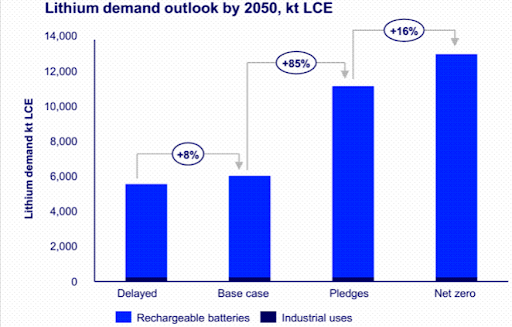
To close that gap, the world needs between US$104 billion and US$276 billion of new investment in lithium supply.4 And 96% to 98% of that lithium is going into batteries. Electric vehicles accounted for 72% to 80% of consumption by mid-century. Battery energy storage is the fastest-growing segment of the entire power sector.
The supply response is not coming from China. China is tightening, not expanding. Zimbabwe banned raw lithium exports, putting roughly 7% of global supply at risk.5 The African build-out is running into permitting, infrastructure, and ESG friction. The Latin American salars have water-scarcity problems that the market is only beginning to understand.
The supply has to come from North America. It has to come from projects that are permittable, fundable, and scalable on the timeline the demand curve requires.
There is one country in that geography with one province with one reservoir that solves every one of those constraints.
Saskatchewan. The Duperow Formation. The heart of the Bakken oil field.
And there is one junior that controls 204,000 net acres of the highest-grade lithium brine ever tested in Canada.6
A junior who increased its total resource by over 78.5% in a single update.7
A junior whose preliminary economic assessment shows a US$1.49 billion NPV, a 55% IRR, and a 2.1-year payback.8
A junior that has received three separate non-dilutive funding commitments from the Government of Canada,9 the Province of British Columbia,10 and the Government of Saskatchewan,11 adding up to almost $8.5 million.
Its market cap today is $67 million (US$48 million).
Its nearest Canadian peer, at a comparable stage of development, is valued at roughly nine times that number.
Meet EMP Metals Corp. (CSE:EMPS) (OTCQB:EMPPF).
SUBSCRIBE FOR TRADING INSIGHTS AND ALERTS. STAY AHEAD.
Get investment opportunities before the rest of the market in real-time.

Get this company's corporate presentation now. Subscribe to download!
Over 120,000 subscribers
The Highest-Grade Lithium Brine Well in Canada
Before you look at anything else, look at the grade.
Lithium concentration is the single most important variable in a brine project. Higher grade means less brine pumped per tonne of lithium recovered. Less brine means smaller facilities, lower reagent consumption, lower power draw, and lower OPEX. Grade compounds through every line on the income statement.
EMP Metals Corp. (CSE:EMPS) (OTCQB:EMPPF) has disclosed the highest identified lithium brine concentration in Canada.
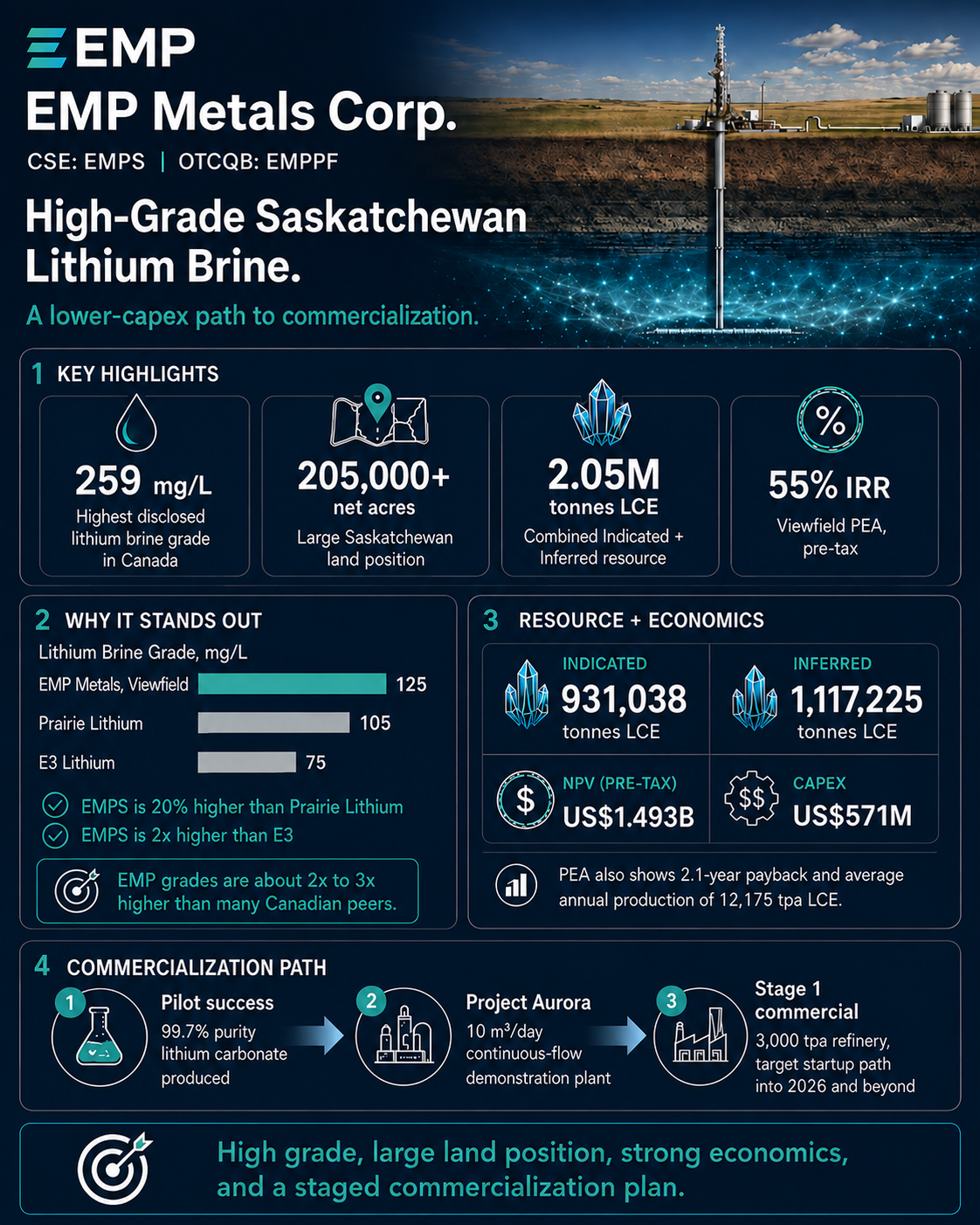
The company’s Viewfield project has measured lithium concentrations up to 259 mg/L. Mansur measured 217 mg/L. The weighted average across the resource is roughly 125 mg/L. Horizontal well flow testing averaged 241 mg/L across a full one-mile, dual-leg completion.13
Compare that to the peer group in Western Canada:
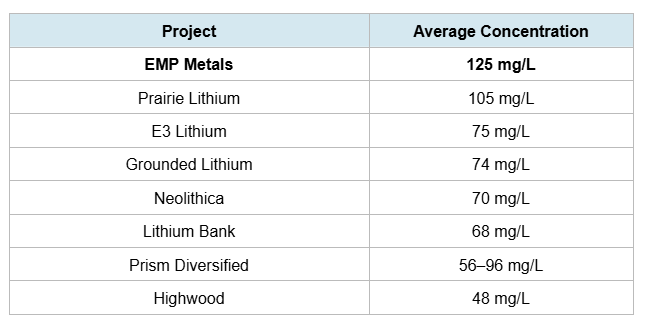
EMP Metals Corp. (CSE:EMPS) (OTCQB:EMPPF) isn’t just ahead of the pack. At Viewfield, the company’s first area of development and now at indicated resource status, average concentration hits 141 mg/L. That’s roughly double the nearest Canadian peers. On a single-zone basis, grades run as high as triple the peer average. In a business where grade compounds through every line of the income statement, that’s the kind of edge that changes the economics of a project.
Now consider what that grade is paired with.
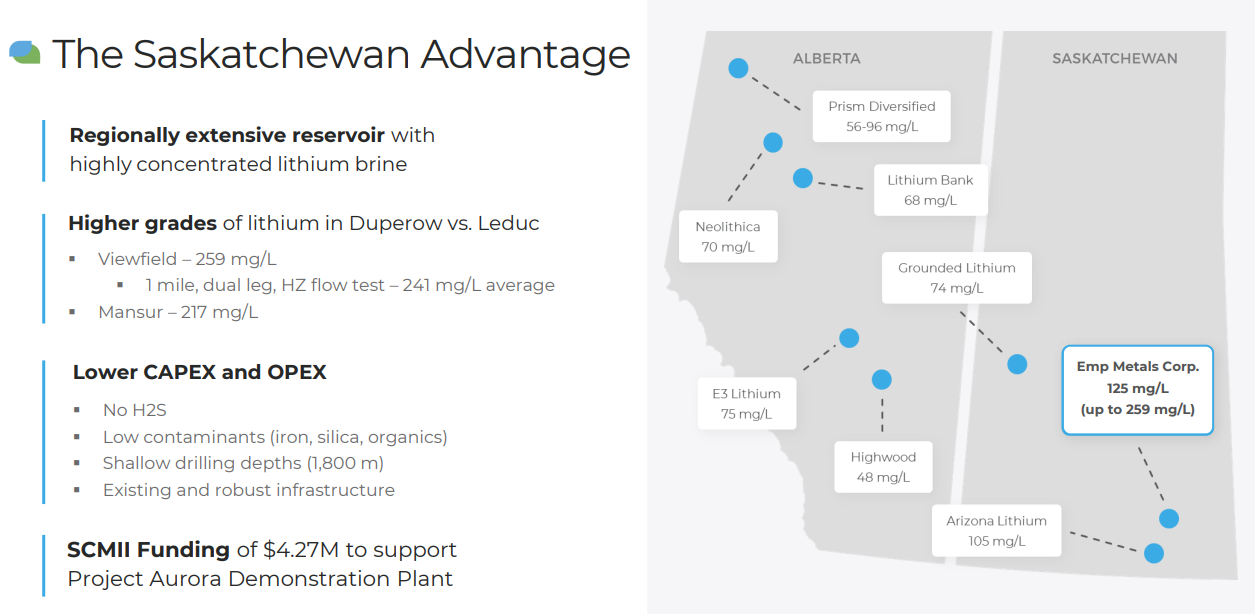
The project sits in the Duperow Formation in southeast Saskatchewan, inside the Bakken oil corridor. That means a century of subsurface data, thousands of wells drilled in the area, and an entire skilled workforce in place. It also means something that almost no other lithium developer in the world can claim: shallow drilling depths of 1,800 metres and a cost of roughly one million dollars per vertical well.
The 78.5% Resource Increase Nobody Is Talking About Yet
On August 12, 2025, EMP Metals Corp. (CSE:EMPS) (OTCQB:EMPPF) announced a substantial increase in its high-grade lithium brine resource across its Viewfield and Mansur projects.14
The headline number is a 78.5% total resource increase across all categories.
The NI 43-101 updated resource now stands at:
- Indicated: 931,038 tonnes LCE at 141 mg/L
- Inferred: 1,117,225 tonnes LCE at 112 mg/L
Combined, that is more than 2.0 million tonnes of lithium carbonate equivalent across a single pair of properties inside a single company that trades for less than one hundred million dollars.
EMP Metals Corp. (CSE:EMPS) (OTCQB:EMPPF) holds 83,000+ hectares, or 204,000 net acres across Hub City Lithium,15 the flagship project area, 90% Crown and 10% Freehold. The Viewfield PEA area alone represents only 14% of the total land position.16
That is the definition of exploration upside sitting inside a producer-grade economic model.
The PEA That Breaks Every Comparable
In 2024, EMP Metals Corp. (CSE:EMPS) (OTCQB:EMPPF) delivered a Preliminary Economic Assessment on the Viewfield Lithium Brine Project that stands up against any lithium study filed in North America this decade.17
The headline numbers:
- Pre-tax NPV (8%): US$1.493 billion
- Pre-tax IRR: 55%
- Payback period: 2.1 years
- Project life: 23.2 years
- Total CAPEX: US$571 million
- Cash operating costs: US$3,319 per tonne
- Average annual production: 12,175 tonnes LCE (18,860 tpa in Years 1-7)
- Assumed selling price: US$20,000 per tonne
Read those numbers once. Then read them again.
A pre-tax IRR of 55% on a 23-year lithium project at a price deck that is roughly 10% below today’s spot. A payback period measured in months, not years. An NPV-to-CAPEX ratio of 2.6 times — meaning every dollar of capital expenditure generates more than two-and-a-half dollars of net present value.
Those are not junior numbers. Those are major-producer numbers at the front end of a junior share price. And they belong to EMP Metals Corp. (CSE:EMPS) (OTCQB:EMPPF).
To put those numbers in context, consider Standard Lithium Ltd. (AMEX:SLI) (TSX:SLI), the most advanced pure-play DLE brine developer in North America.
Standard Lithium’s definitive feasibility study for its South West Arkansas project, filed in October 2025, shows a pre-tax NPV of US$1.666 billion against a total CAPEX of US$1.45 billion. Pre-tax IRR: 20.2%. Cash OPEX: US$4,516 per tonne.18
Standard Lithium trades at a market cap of approximately US$869 million, roughly $1.3 billion at current exchange rates.
EMP Metals Corp. (CSE:EMPS) (OTCQB:EMPPF) trades at US$48 million.
A side-by-side:
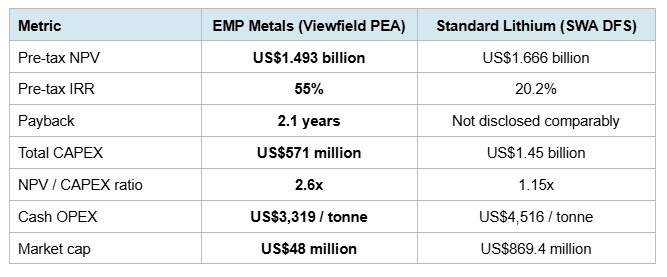
The core economics are comparable. The capital efficiency favours EMP Metals Corp. (CSE:EMPS) (OTCQB:EMPPF) by a wide margin. The market cap gap is roughly 18 to 1.
This is not a matter of opinion. It is a matter of when the market looks at the numbers.
Three Levels of Canadian Government. One Project.
Sophisticated investors do not underwrite lithium projects on price decks alone. They underwrite jurisdictions, permitting pathways, and the degree of alignment between the developer and the public sector.
In that dimension, EMP Metals Corp. (CSE:EMPS) (OTCQB:EMPPF) has built something genuinely unusual.
Three separate levels of Canadian government have put non-dilutive capital behind the company’s demonstration plant program over the last eight months.
September 17, 2025 — Government of Saskatchewan: up to $4.27 million in transferable royalty tax credits under the Saskatchewan Critical Minerals Innovation Incentive (SCMII).19
March 2, 2026 — Province of British Columbia, via Innovate BC’s Integrated Marketplace: up to $1.0 million for technology development and deployment in the Project Aurora demonstration plant.20
April 15, 2026 — Government of Canada, through Next Generation Manufacturing Canada: up to $3.2 million to advance one of the country’s first direct wellhead-connected, continuous-flow lithium demonstration plants.21
Combined, that is a non-dilutive funding stack approaching $8.5 million from three different arms of the Canadian government, all directed at the same project, all announced inside a single fiscal cycle. EMP Metals Corp. (CSE:EMPS) (OTCQB:EMPPF) is, as far as public disclosure suggests, the only Canadian lithium junior with this breadth of public-sector alignment.
Money is the easy part. What matters is what the money signals. Three levels of government do not sign up for the same project unless that project is regarded internally as strategically important.
And the geography backs them up. The Fraser Institute’s Annual Survey of Mining Companies ranks Saskatchewan as the third most attractive mining jurisdiction worldwide and first in Canada.23
In September 2025, the Saskatchewan government formally set the lithium production royalty rate at 3%,24 giving EMP Metals Corp. (CSE:EMPS) (OTCQB:EMPPF) fiscal certainty that most global lithium developers will never enjoy.
Project Aurora Is Not Just a Demo Plant. It Is the Blueprint for Commercial Production.
The surest way to reduce investor risk in a lithium brine project is to prove the flowsheet. Prove that the brine coming out of the reservoir can be turned into lithium chemicals. Prove it continuously. Prove it from a real well. Then prove that the same system can be repeated at commercial scale.
That is the real purpose of Project Aurora.
EMP Metals Corp. (CSE:EMPS) (OTCQB:EMPPF) has already cleared the first major technical hurdle at pilot scale.
On December 10, 2024, the company reported that its Viewfield Pilot Program had successfully produced 99.7% purity lithium carbonate from Duperow brine.25
That single data point matters because it addresses one of the most common failure points in lithium brine development: whether the impurities can be rejected and the final product can meet high-purity specifications.
In simple terms, EMP Metals Corp. (CSE:EMPS) (OTCQB:EMPPF) has already shown that its Saskatchewan brine can be turned into the right product.
Project Aurora is designed to answer the next, larger question: can that process run continuously, from a real well-connected and highly automated field system, in a format that can become a repeatable commercial production model?
Developed in partnership with Saltworks Technologies, a British Columbia-based water-treatment and critical-minerals processing specialist, Project Aurora is where those pilot results become a commercial-scale roadmap.
Phase 1 is designed as a fully integrated, continuous-flow, 10 m³/day well-connected hub-and-spoke demonstration plant at Viewfield, with startup targeted for Q3 2026 and 12 to 18 months of planned operations.
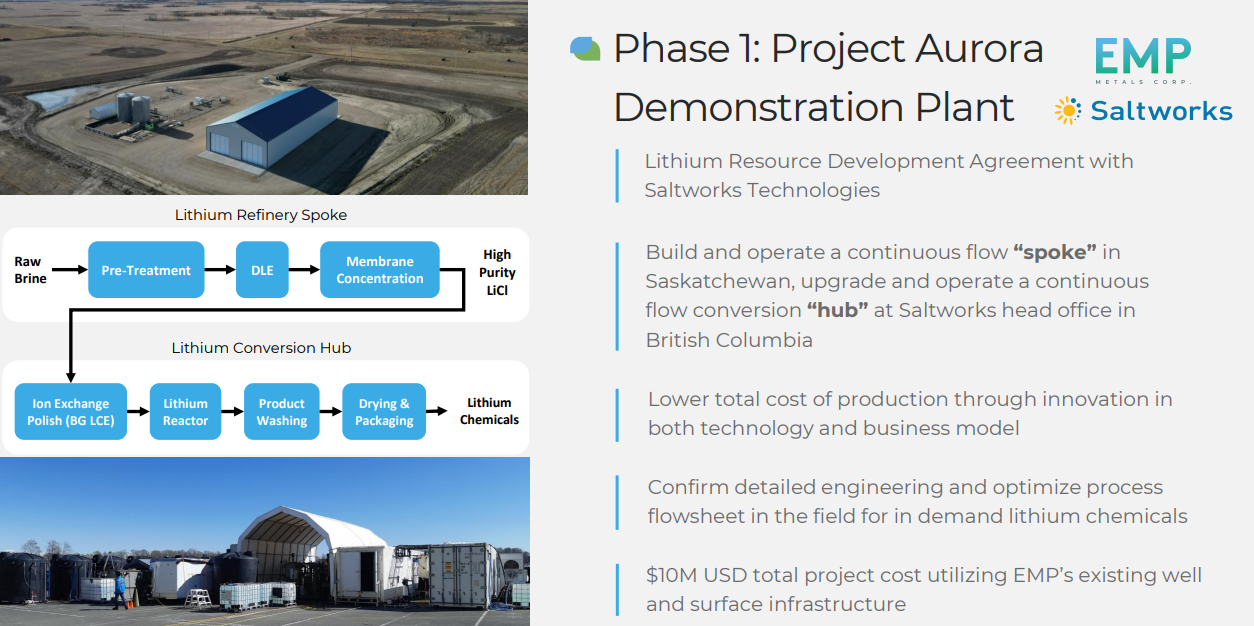
This is not a lab exercise. It is the bridge between pilot success and commercial production.
The hub-and-spoke model is the key update. At the front end, raw brine is processed through pre-treatment, direct lithium extraction, and membrane concentration at the Saskatchewan “spoke” to produce high-purity lithium chloride. That material is then sent to the lithium conversion “hub,” where it is processed through polishing, lithium reaction, product washing, drying, and packaging to produce lithium chemicals.
That structure gives EMP Metals a more practical path to commercialization than a single, all-or-nothing mega-project.
Phase 2 is now framed as a Stage 1 commercial plant: a planned 3,000 tonne-per-year lithium carbonate refinery using two 1,500 tonne-per-year spokes, and one 3,000 tonne-per-year hub, with estimated CAPEX of approximately US$180 million. That figure is expected to be further refined through Project Aurora.
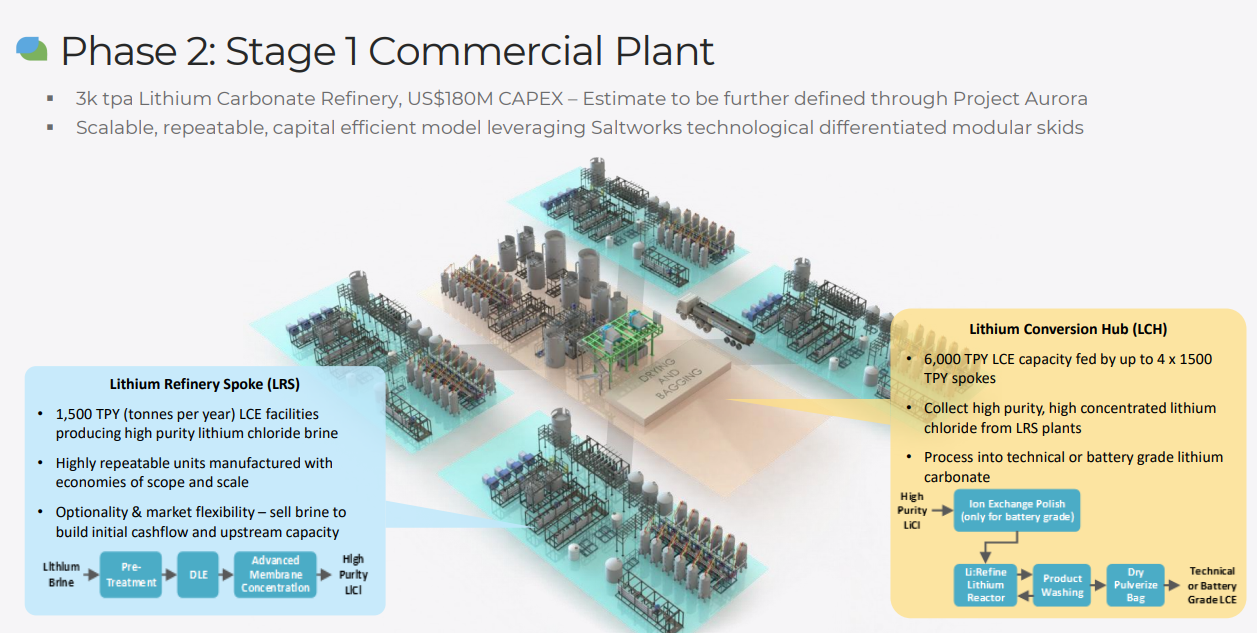
That matters because EMP Metals Corp. (CSE:EMPS) (OTCQB:EMPPF) does not need to jump immediately from the Project Aurora Demo Plant to the full US$571 million Viewfield PEA development case. It can pursue a smaller, modular first commercial build, then repeat the model across its Saskatchewan land holdings.
Detailed engineering, feasibility study work, and project financing for the Stage 1 commercial plant are expected to occur in parallel with demonstration plant operations. Subject to financing, major procurement and construction could begin as early as Q1 2027.26
Saltworks’ role also adds technical credibility to the commercialization path.
Saltworks unveiled its Generation II DLE technology in October 2025, and Project Aurora is now tied to that next-generation flowsheet through FEED work.27 Saltworks’ separate selection by a global semiconductor manufacturer for an advanced water recovery and zero-liquid-discharge project further reinforces the depth of the processing partner EMP Metals has chosen for its refinery backbone.28
That is the commercialization story investors should be watching.
Phase 1 is Project Aurora. Phase 2 is the first 3,000 tpa commercial plant. Phase 3 is repeat commercial implementation across Saskatchewan, built around multiple 1,500 tpa spokes feeding 6,000 tpa conversion hubs.
In other words, EMP Metals Corp. (CSE:EMPS) (OTCQB:EMPPF) is not just trying to prove that Saskatchewan brine can produce lithium carbonate. It has already demonstrated that at pilot scale with the 99.7% purity result. Now, Project Aurora is designed to prove that Saskatchewan brine can support a repeatable, lower-CAPEX production system.
That is a much bigger story than a demo plant.
SUBSCRIBE FOR TRADING INSIGHTS AND ALERTS. STAY AHEAD.
Get investment opportunities before the rest of the market in real-time.
Get this company's corporate presentation now. Subscribe to download!
Over 120,000 subscribers
The CAPEX Story the Lithium Sector Is Missing
The lithium sector is not short on big projects.
But it is short on projects that can show a practical path from resource to production without needing a multi-billion-dollar construction budget.
That is where EMP Metals Corp. (CSE:EMPS) (OTCQB:EMPPF) starts to look different.
Lithium Americas Corp. (NYSE:LAC), developing the Thacker Pass project in Nevada in partnership with General Motors, now carries a Phase 1 CAPEX estimate of US$2.93 billion for 40,000 tonnes per annum of battery-grade lithium carbonate.29
The financing package includes a US$2.23 billion US Department of Energy loan and a US$945 million total investment from General Motors. Lithium Americas has also guided to US$1.3 billion to US$1.6 billion of 2026 CAPEX for Thacker Pass Phase 1 alone.
Standard Lithium’s South West Arkansas project is another advanced DLE comparison. Its Phase 1 project has a reported CAPEX of US$1.449 billion and is backed by a finalized US$225 million US Department of Energy grant to support construction of the first phase.
PMET Resources’ Shaakichiuwaanaan lithium project in Quebec is now scheduled for a late-2026 updated feasibility study that incorporates tantalum co-products; the prior CV5 lithium-only FS drove a post-tax NPV of roughly $1.595 billion on a 20-year mine life targeting ~800 ktpa SC5.5 spodumene. PMET’s market cap: US$813.4 million.
Sigma Lithium Corporation (NASDAQ:SGML) is already producing in Brazil at 240,000 tonnes per annum of SC5.5 concentrate. Its Phase 2 expansion to 520,000 tpa requires US$80 million of capex. Phase 3, to 770,000 tpa, requires another US$100 million.30 Sigma’s market cap: US$1.76 billion.
Against that peer set, look at what EMP Metals Corp. (CSE:EMPS) (OTCQB:EMPPF) is carrying on its books:
-
- PEA CAPEX: US$571 million for 12,175 tpa average annual LCE production
- Shallow vertical wells at ~US$1 million each
- Clean Saskatchewan brine with no hydrogen sulfide (H2S) and minimal organics, allowing for minimal pre-treatment before DLE, an advantage EMP’s processing partner Saltworks has publicly described as “high quality and clean” relative to competing brine sources31,32
- No tailings ponds. No evaporation ponds.
- Existing oilfield infrastructure across the entire land package
- 90% water recovery via reverse osmosis on brackish, non-potable water
- Minimal surface footprint on flat, unobstructed farmland
The Viewfield PEA CAPEX that EMP Metals Corp. (CSE:EMPS) (OTCQB:EMPPF) carries is roughly 40% of Standard Lithium’s SWA figure and approximately 20% of Lithium Americas’ Thacker Pass Phase 1.
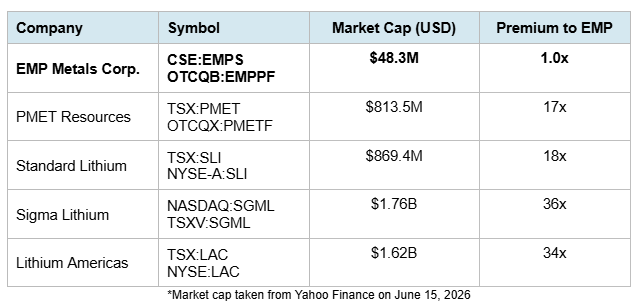
A re-rating to a fraction of the nearest peer market cap represents multiple times the current enterprise value.
And unlike the majors, EMP Metals Corp. (CSE:EMPS) (OTCQB:EMPPF) does not need to execute against a multi-billion-dollar construction budget to prove the model. It needs to deliver a demonstration plant, an updated resource statement, and a financing path to Stage 1 commercial.
The Drilling Economics You Cannot Build Anywhere Else
One passage from an interview with CEO Karl Kottmeier captures why this project is different from virtually every other lithium brine development on the continent:33
That sentence is doing an enormous amount of work.
One million dollars per vertical well.35
At 1,800 metres. In an active oilfield with an existing service industry. With no geological surprises, because the Bakken Corridor is one of the most extensively drilled basins on the planet. EMP Metals Corp. (CSE:EMPS) (OTCQB:EMPPF) does not have to invent new well-design science. It just has to drill.
A Clayton Valley lithium brine project in Nevada has had to drill and complete aquifer-specific test wells to define producible intervals, including CV-8, which reached 3,194 feet, or 974 metres, and was designed to isolate and test separate shallow and deeper aquifer zones.
A Salton Sea geothermal-lithium project involves a hotter, deeper system, with Controlled Thermal Resources targeting wells of approximately 8,000 feet and brine temperatures of 550°F to 650°F, adding drilling, completion, corrosion, and operating complexity.
A Thacker Pass-style clay-hosted deposit carries a different kind of scale-up risk: lithium must be leached from claystone using a purpose-built processing flowsheet, a model that is still being proven at commercial scale.
EMP Metals Corp. (CSE:EMPS) (OTCQB:EMPPF), by contrast, is working in southeast Saskatchewan’s established oilfield corridor, where the Duperow reservoir sits at roughly 1,800 metres and vertical wells are estimated at approximately $1 million before equipping and pumping costs.
That is why the drilling economics matter. Combined with grade that runs roughly double the nearest Canadian peers and brine chemistry that is notably cleaner than many global comparables, the Viewfield PEA carries a capital profile that looks very different from most competing lithium development stories.
EMP Metals Corp. (CSE:EMPS) (OTCQB:EMPPF) is not trying to force a new mining model into existence from scratch. It is applying lithium extraction to a reservoir system, drilling environment, and service corridor that Saskatchewan already understands.
The Team That Has Raised a Quarter of a Billion Dollars Before
A junior lithium developer can have the best rock on the planet and still fail if the people running it cannot raise money, move through permitting, and negotiate with governments.
EMP Metals Corp. (CSE:EMPS) (OTCQB:EMPPF) is not that kind of junior.
EMP Metals Corp. (CSE:EMPS) (OTCQB:EMPPF) has a CEO who has raised a quarter of a billion dollars. A COO who has diversified engineering experience onsite at the world’s largest Potash solution mine. Two strategic shareholders (Tembo and ROK) with combined ownership of more than 37%, both with deep subsurface and natural-resource pedigree. Founders retain 38%. Brokers, 17%. Retail float, 8%.36
That is not a promotional cap table. That is a cap table built for a multi-year development program.
The Catalyst Calendar. The Next 12 Months Are Not Quiet.
Junior lithium stocks re-rate on catalysts. EMP Metals Corp. (CSE:EMPS) (OTCQB:EMPPF) has built the most stacked near-term catalyst calendar in the Canadian lithium space for 2026.
They are not just resource updates or government funding announcements. They’re commercialization milestones.
Project Aurora commissioning and first continuous-flow data. Phase 1 is Project Aurora, a fully integrated, continuous-flow, 10 m³/day well-connected hub-and-spoke demonstration plant. Startup is targeted for Q3 2026, with 12 to 18 months of planned operations. The system runs a continuous-flow lithium refinery “spoke” in Saskatchewan and a continuous-flow conversion “hub” at Saltworks Technologies’ head office in British Columbia. The goal is to confirm detailed engineering,optimize the process flowsheet in the field for in-demand lithium chemicals, and increase certainty on commercial project economics and scale up. This is the central near-term catalyst. It is where EMP Metals Corp. (CSE:EMPS) (OTCQB:EMPPF) stops piloting and starts proving the process at continuous, well-connected scale.37
Stage 1 commercial scope coming into focus. Detailed engineering and feasibility study work are designed to occur in parallel with Project Aurora’s operations. The Stage 1 commercial plant is framed as a 3,000 tpa lithium carbonate hub-and-spoke refinery — two 1,500 tpa spokes producing high-purity lithium chloride feeding a 3,000 tpa conversion hub capable of producing technical or battery-grade lithium carbonate — with an estimated US$180 million CAPEX, to be further defined through Project Aurora.
Project financing and a possible Q1 2027 construction start. Project financing for the Stage 1 plant is expected to advance in parallel with Project Aurora. Subject to securing that financing, major procurement and construction could begin as early as Q1 2027. That is the milestone that shifts the market’s view from a company testing a demonstration plant to a company preparing for first commercial production. It is also the point at which the project moves from a CAPEX estimate on a slide to a fully funded commercial build.
Updated Feasibility Study on the expanded resource at current lithium prices. The 2024 Viewfield PEA was modelled on a pre-update resource at a US$20,000 per tonne lithium deck. The resource has since grown to over 2.0 million tonnes LCE across Indicated and Inferred categories, and the current spot price is over US$27,000 per tonne — roughly 35% above the PEA assumption. An updated economic model that incorporates both the larger resource and the higher price deck would flow directly into a higher NPV, a higher IRR, and a faster payback. This is the catalyst most directly comparable to the kind of disclosure that re-rated Standard Lithium after its DFS.
Every one of these items points to the same core idea: Project Aurora is not the end goal. It is the bridge.
The next stage of news flow is designed to answer the question retail investors care about most: can EMP Metals Corp. (CSE:EMPS) (OTCQB:EMPPF) move from a high-grade Saskatchewan lithium brine discovery into a repeatable, modular production model?
If Project Aurora works the way it is designed to work, the story changes. EMP Metals is no longer just advancing a lithium brine project. It is building the first proof point for a commercial system that could be repeated across one of Canada’s strongest mining jurisdictions.
Saltworks, Sustainability, and the ESG Story the Majors Cannot Replicate
There is a dimension to this project that almost nobody outside Saskatchewan fully appreciates: the ESG profile is, quite simply, best in class.
EMP Metals Corp. (CSE:EMPS) (OTCQB:EMPPF) uses no fresh water. Its production model calls for 90% water recovery during refining, with make-up water sourced through reverse osmosis of non-potable brackish water.38
The project has no tailings ponds and no surface brine ponds. It does not disturb the surface of the farmland on which it operates. Wells are drilled, produced, reinjected, and abandoned on a pattern that is operationally indistinguishable from mature oilfield operations.
Compare that to a South American salar, which typically requires hundreds of square kilometres of evaporation pond footprint and hundreds of thousands of gallons per day of fresh water in an arid basin. Compare it to a spodumene hard rock operation, which requires open-pit mining, heavy strip ratios, tailings management, and in most cases, coal-fired calcination. EMP Metals Corp. (CSE:EMPS) (OTCQB:EMPPF) sidesteps every one of those ESG exposures.
The Saltworks partnership amplifies the ESG alignment. Saltworks is a British Columbia-based water technology company whose technology is, in many cases, the mitigation for problems at other lithium projects. Saltworks has signed on to build and operate the Lithium Refinery Spoke and the Lithium Conversion Hub demonstration equipment as part of Project Aurora.
On April 7, 2026, Saltworks was selected by a global semiconductor manufacturer for an advanced water recovery and zero-liquid-discharge project. Semiconductor fabs have some of the strictest water standards on the planet. Saltworks passed that bar.39
That is the same partner building EMP Metals’ (CSE:EMPS) (OTCQB:EMPPF) refining infrastructure.
The Capitalization Table. Why the Float Matters.
EMP Metals Corp. (CSE:EMPS) (OTCQB:EMPPF) currently has 120,156,917 shares issued and outstanding. Fully diluted, including warrants (9,831,794), options (10,475,000), and the Tembo Convertible Debenture (9,741,176), the figure is 150,204,887.
The share price as of June 15, 2026 was $0.56, putting the market capitalization at $67.28 million. The 52-week range is $0.21 to $1.03.
Ownership is concentrated with strategic, long-duration holders:
- Founders: 38.0%
- Tembo Capital: 19.9%
- ROK Resources: 17.1%
- Brokers: 17.0%
- Retail: 8.0%
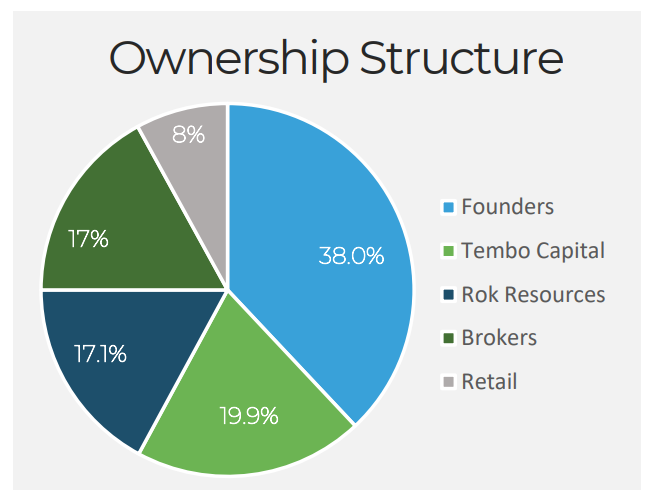
Tembo Capital and ROK Resources are not promotional capital. They are operating institutions with deep natural-resource investment histories. Together they control 37% of the equity in EMP Metals Corp. (CSE:EMPS) (OTCQB:EMPPF). The founders control another 38%. That is 75% of the float in the hands of people who are not selling into the next catalyst.
When a catalyst-driven re-rate hits a company with this kind of tight register, the move is rarely gradual.
The Setup Is Right in Front of You
Let us go back to the beginning.
Lithium demand is doubling by 2030 and tripling by 2035. Wood Mackenzie’s own analyst said deficits emerge as early as 2028 under Net Zero, and that investment decisions made today will determine market balance in the critical 2030s. The supply response has to come out of North America. China is tightening. Zimbabwe is closing. The salars are water-constrained.
Inside North America, the lowest-cost, highest-grade, most permittable lithium brine project in Canada is a 120-million-share junior trading at US$51 million.
The average grade is roughly double the nearest Canadian peer. The resource just grew 78.5% in a single update. The PEA shows a US$1.49 billion NPV, a 55% pre-tax IRR, and a 2.1-year payback on a US$600 million CAPEX, a fraction of the build cost of comparable PEA-stage lithium projects in North America. Three levels of Canadian government have committed nearly $8.5 million in non-dilutive funding to the demonstration plant. Battery-grade 99.7% lithium carbonate has already been produced from Viewfield brine at pilot scale.
The comparables — Standard Lithium, PMET Resources, Sigma Lithium, Lithium Americas — carry market caps between 19 to 51 times larger. Their PEAs and DFSs do not clear the 55% IRR bar that EMP Metals Corp. (CSE:EMPS) (OTCQB:EMPPF) cleared two years ago. Their CAPEXs are multiples higher. Their permitting pathways are longer. Their government-funding stacks, in most cases, are no larger.
The catalyst calendar is live. Project Aurora is commissioning in Q3 2026. The Frankfurt listing is live. The updated PEA on the new resource is on the horizon.
You have a Canadian lithium junior holding the highest-grade brine well in the country, permitted and funded and underpinned by a management team that has raised a quarter of a billion dollars before. It trades for less than one hundred million dollars.
The window to position ahead of the catalyst stack is open today. It is not going to stay that way once the demonstration plant starts producing lithium carbonate from a Duperow wellhead.
Enter your email below to receive the full EMP Metals Corp. corporate presentation and ongoing updates directly to your inbox.
SUBSCRIBE FOR TRADING INSIGHTS AND ALERTS. STAY AHEAD.
Get investment opportunities before the rest of the market in real-time.
Get this company's corporate presentation now. Subscribe to download!
Over 120,000 subscribers
*All figures in Canadian dollars unless otherwise stated.