In a cornfield outside Cedar Rapids, Iowa, engineers are walking the halls of a nuclear plant that went dark six years ago.
The Duane Arnold Energy Center was killed by a windstorm in 2020 and left for dead. This month, the US Department of Energy finalized a $1.9 billion loan to NextEra Energy to bring it back from the grave.1 The company paying for most of its power for the next 25 years is Google. The search giant is already scouting a data center on the land directly next door.2,3 NextEra’s chief executive, John Ketchum, has a name for this moment: “America’s golden age of power demand.”4

Read that again. Google did not just buy nuclear power. It resurrected a dead reactor to get it. Restarting Duane Arnold means 615 megawatts back on the grid, enough for roughly half a million homes, and it is only the third restart the federal loan office has financed this cycle, a signal that Washington intends to keep writing these cheques.5
And it is not alone. Microsoft’s $16 billion, 20-year agreement with Constellation Energy is restarting Three Mile Island, the most famous shuttered reactor in America. Meta has locked up as much as 6.6 gigawatts of nuclear capacity across four suppliers. Amazon led a $700 million investment in X-energy’s small modular reactors. By mid-2026, thirteen announced deals had committed nearly 10 gigawatts of nuclear power to one purpose: feeding artificial intelligence.6
Why the panic buying? Because the math stopped working. Global data center electricity use was about 415 terawatt-hours in 2024 and is projected to more than double to roughly 945 TWh by 2030, with AI-focused data centers alone growing 50% in 2025.7 The world’s server halls are on their way to consuming as much electricity as Japan.8 Only one power source delivers that around the clock, rain or shine, without emissions. Its fuel is uranium.
Now look at what that fuel costs. Uranium is trading near $90 per pound, its highest since early February, and on the futures board it has printed all-time highs this month.9,10
Long-term contract prices are the highest in at least 18 years. Jefferies just raised its long-term uranium forecast 36% to $95 per pound. Citi sees $140 by late 2027. And enriched uranium has more than tripled to $190 per unit in three years, because the West simply cannot process enough of it.11,12 Underneath it all, the market is entering a structural deficit after a decade of underinvestment.13
Governments are pulling in the same direction. One year after sweeping executive orders set out to quadruple US nuclear capacity, restarts and new builds are moving at a pace the industry has not seen in a generation, and 31 nations have pledged to triple global nuclear capacity by 2050.14,15 The International Atomic Energy Agency now projects capacity could triple by 2060.16
Here is the part almost everyone misses. Every reactor deal Google, Microsoft, Meta and Amazon sign is a future purchase order for fuel. Fuel comes from mines. Mines come from discoveries. And there have been precious few new discoveries anywhere on earth.
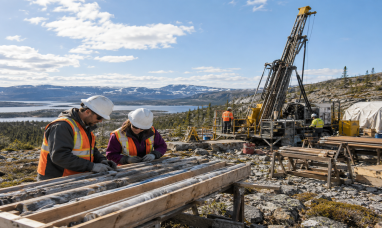
Which is why the most interesting place in this whole story is not a boardroom in Silicon Valley or a trading desk in London. It is a helicopter-supplied drill camp in the wilds of Labrador, where the rigs started turning this month.
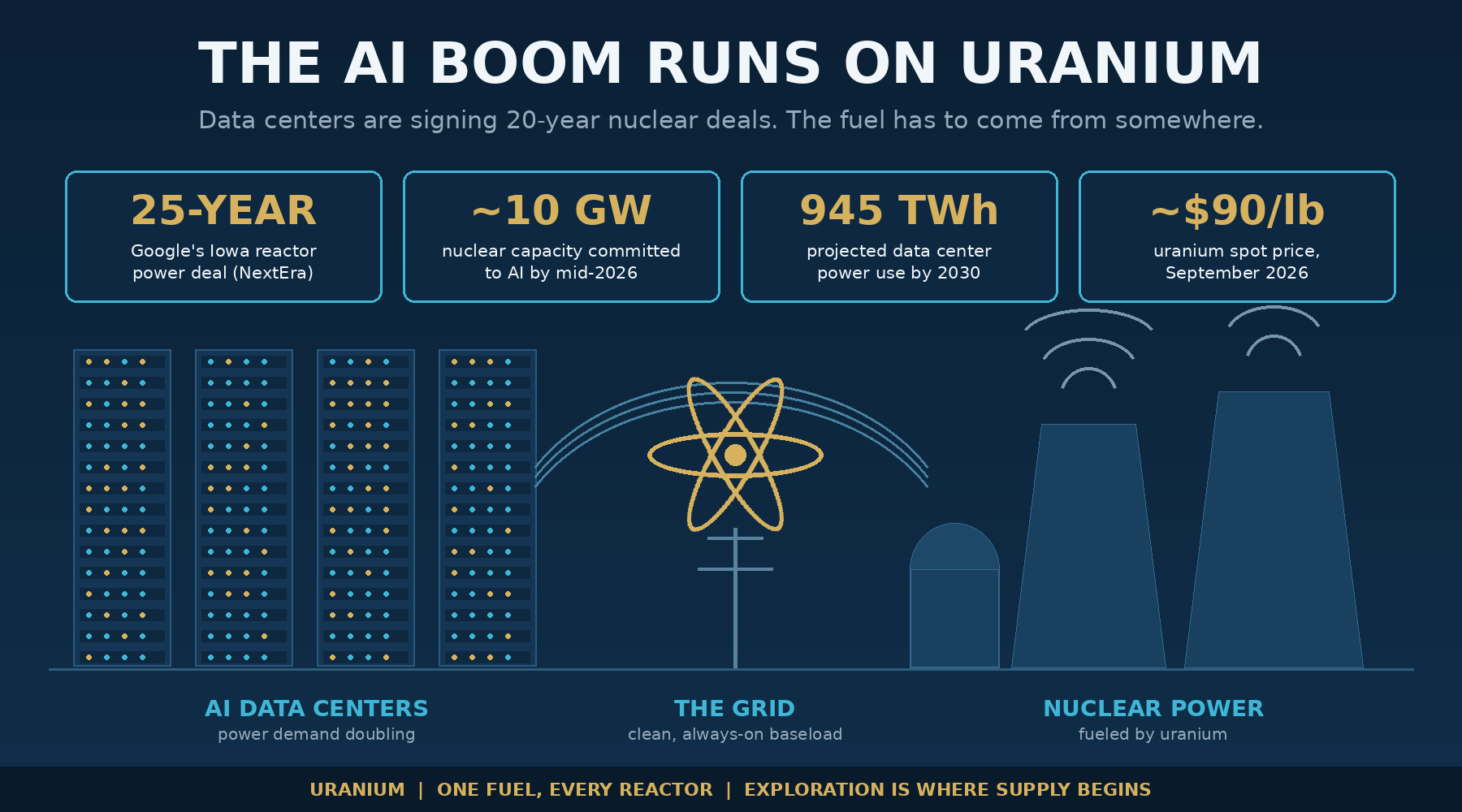
The AI power chain: data centers, the grid, nuclear, and the uranium underneath it all. Author graphic; sources cited throughout this article
That drill belongs to Azincourt Energy Corp. (TSXV:AAZ) (OTCQB:AZURF), a Canadian uranium explorer with three projects across two of the country’s premier uranium belts: the Central Mineral Belt in the province of Newfoundland and Labrador, where it is drilling the Snegamook deposit inside its approximately 13,000-hectare Harrier Project and adding the high-grade Sylvia Lake project under option, and Saskatchewan’s Athabasca Basin, home of its East Preston project.17,18 Drilling began in early September, roughly 2,000 metres in 6 to 10 holes, designed to gather the data the company needs as it works toward a potential maiden NI 43-101 mineral resource estimate.19
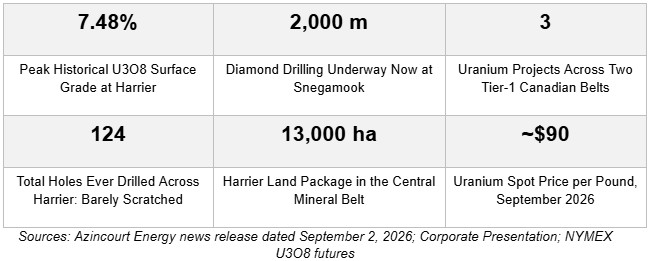
Those are the bones of the story. Now here is why the ground Azincourt Energy Corp. (TSXV:AAZ) (OTCQB:AZURF) chose matters as much as the timing.
The Last Overlooked Uranium Belt in Canada Has Three Landholders and One Is Still Priced Like a Secret
Everyone knows the Athabasca Basin, where the company also holds ground. Far fewer investors know Newfoundland and Labrador’s Central Mineral Belt, a district roughly 260 kilometres by 75 kilometres that hosts multiple large uranium deposits and has never produced a single pound, leaving its endowment in the ground while the market chased better-known addresses.21,22
The neighbours tell you what the rocks can hold. Paladin Energy’s Michelin Project, six deposits reported to contain a combined 127.7 million pounds of U3O8 in reserves and resources, sits on trend. So do ATHA Energy’s Moran Lake C deposits, reported to hold roughly 9.3 million pounds of U3O8 plus 25.3 million pounds of vanadium, and the Anna Lake deposit at 4.9 million pounds.23 Those figures are the neighbours’ own, provided for regional context, and are not necessarily indicative of what Harrier holds. But they are why Azincourt Energy Corp. (TSXV:AAZ) (OTCQB:AZURF) calls the CMB a tier-1 district, and why the company, Paladin and ATHA now stand as the belt’s three large landholders.24
The CMB has been teasing geologists for seventy years. Uranium was first found here in the 1950s, staking rushes came and went with every uranium cycle, and the belt produced discovery after discovery without ever producing a mine. When the post-Fukushima winter set in, the juniors left, the claims lapsed, and a district that hosts one of the largest undeveloped uranium deposits on earth went quiet.25 That silence is the opportunity.
Why was a district this endowed left alone? Partly geography, partly history: exploration here surged in the late 2000s, stalled with the uranium bear market, and never restarted at scale, leaving the CMB, in the company’s words, relatively underexplored relative to its geological potential.26 In 2024, while the crowd bid up Athabasca ground, “+CO+” moved the other way and consolidated Harrier, one of the largest land positions in the belt, for exploration-stage consideration. The result is a three-landholder district where two companies carry the pounds and the market caps, and Azincourt Energy Corp. (TSXV:AAZ) (OTCQB:AZURF) is the one drilling to find out what its ground holds.27
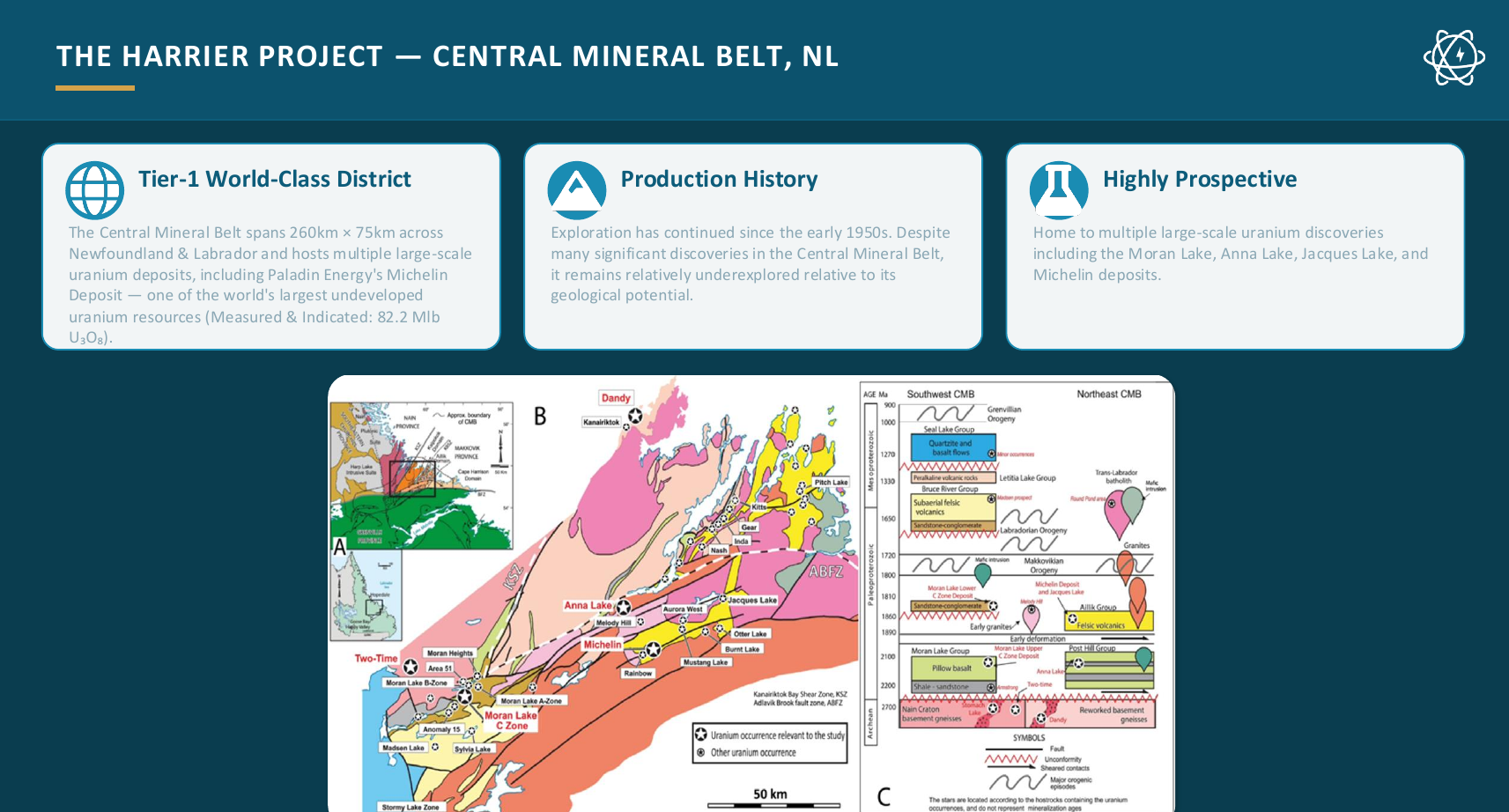
The Harrier Project in the Central Mineral Belt, adjacent to and on trend with the Michelin, Moran Lake C and Anna Lake deposits. Source: Azincourt Energy Corporate Presentation
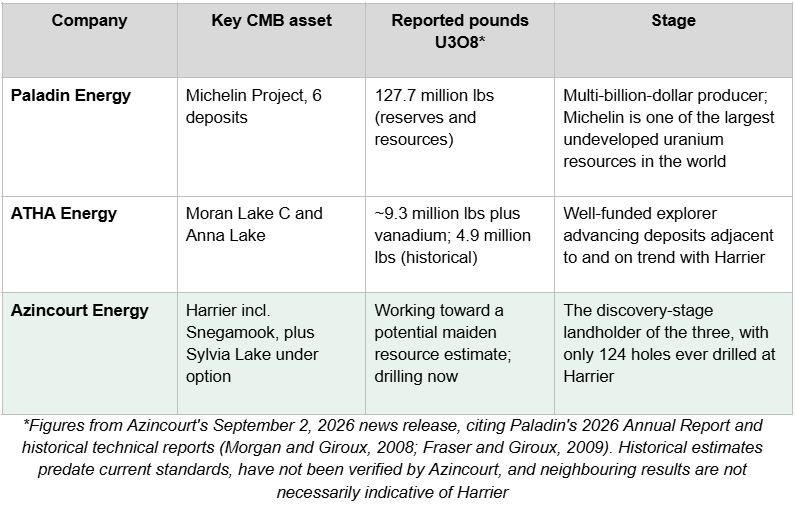
Read the comp table the way a mining executive would. The heavyweight proves the belt can host world-class scale. The mid-sized neighbour proves modern exploration still adds pounds here. And the third landholder, Azincourt Energy Corp. (TSXV:AAZ) (OTCQB:AZURF), the one with the smallest market footprint and the freshest drill program, is the one still testing what its ground holds. None of the neighbours’ results guarantee similar results at Harrier.
In tightly held districts, every landholder’s news can draw attention to the whole belt: a resource update at Michelin, a discovery at Moran Lake, or a new set of Harrier assays all remind the market that the CMB is one of the last places on earth where a junior can still assemble belt-scale uranium ground.28 Consolidation has been the endgame in every major uranium district, and juniors holding confirmed high-grade ground beside producers have historically been where that story starts.
Large reported deposits nearby, and in the middle sits Azincourt Energy Corp.‘s (TSXV:AAZ) (OTCQB:AZURF) approximately 13,000-hectare project where only 124 holes have ever been drilled.29,30 That is the setup the company spent the last year assembling, and it is why the current program matters so much.
Snegamook: The Deposit With a Drill Turning in It Right Now
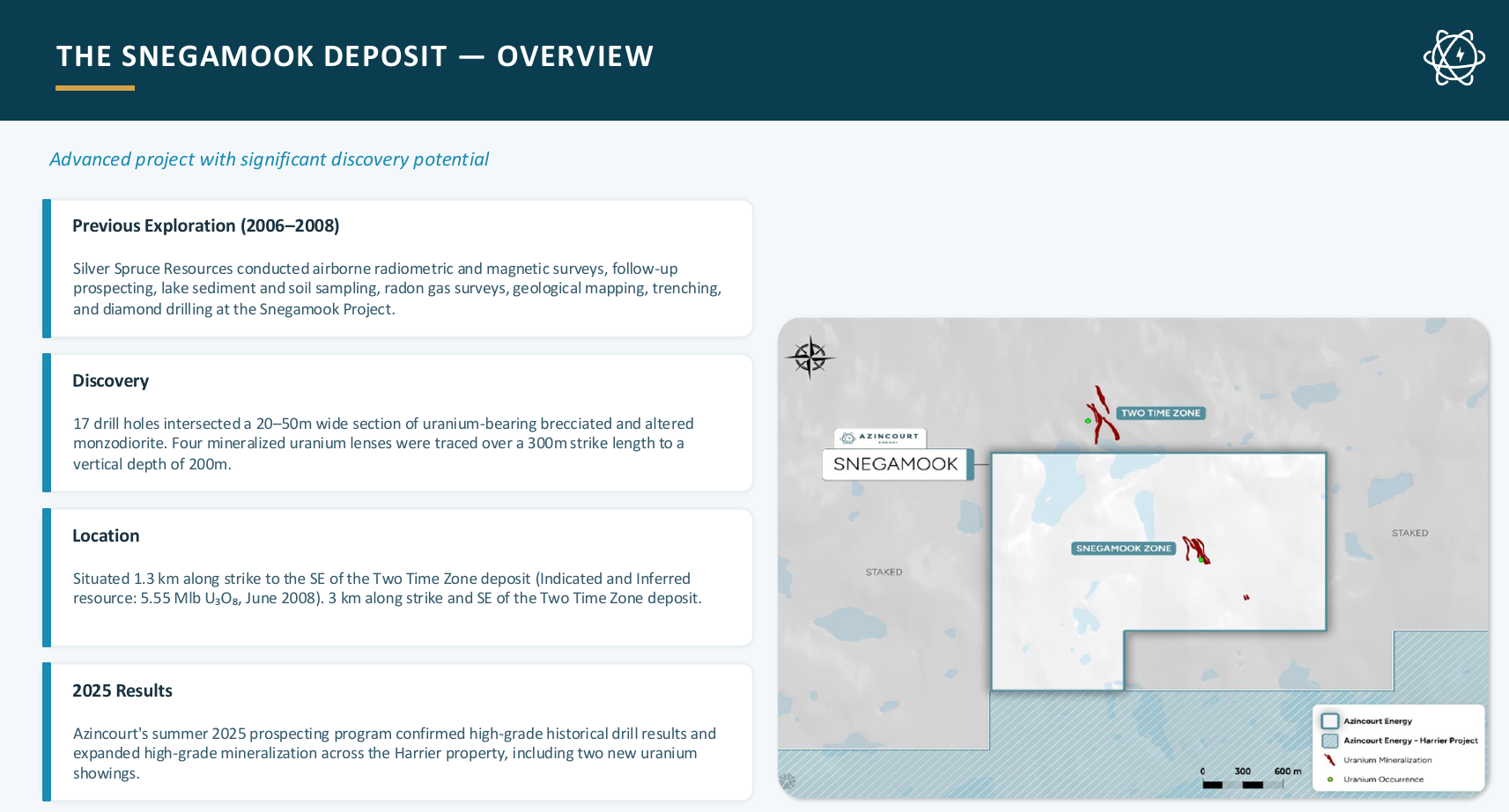
The Snegamook deposit, 1.3 kilometres from the Two Time Zone deposit. Source: Azincourt Energy Corporate Presentation
Snegamook is not a blank patch of tundra. Historical drilling in 2007 and 2008 put seventeen holes into a 20-to-50-metre-wide section of uranium-bearing, brecciated and altered monzodiorite, 1.3 kilometres southeast of the Two Time Zone deposit and interpreted as a similar geological setting. The best historical interval graded 0.97% U3O8 over 0.5 metres, and in 2008 a preliminary resource estimate was prepared but never finalized or filed, meaning the deposit slipped out of the market’s memory entirely.32
Then Azincourt Energy Corp. (TSXV:AAZ) (OTCQB:AZURF) went back and checked the core. A 10-centimetre check sample from hole SN-08-06, taken from that best historical interval, returned 2.71% U3O8.33 Check samples of that size are selective by nature and not representative of overall grade or width, as the company is careful to note. What they confirm is simpler and more important: the uranium is exactly where the old drilling said it was.
The 2,000-metre program now underway is built gather the confirmatory data needed: rehabilitating and re-examining the historical core, twinning selected holes, testing the extent of known mineralization, and engaging an independent Qualified Person, all feeding the company’s evaluation of a potential maiden NI 43-101 compliant resource estimate for Snegamook.34
In the junior market, the moment a deposit goes from story to stated pounds is the moment generalist money can finally underwrite it. It is also the moment comparisons stop being abstract: pounds in the ground can be measured against the pounds next door, and the company would become the belt’s third resource-stage story rather than its best-kept secret.
It is worth being precise about what this program is, because it is rarer than it sounds. Most juniors drill hoping to find something. Azincourt Energy Corp. (TSXV:AAZ) (OTCQB:AZURF) is drilling to verify something already reported: seventeen historical holes, four defined mineralized lenses traced over a 300-metre strike length to a vertical depth of 200 metres, and mineralization mapped at surface.35,36 Twinning historical holes is the standard, Qualified-Person-supervised path for converting old data into a modern resource, and it carries far lower risk than grassroots drilling. The drill is asking how much of what the old operators reported can be confirmed, and whether the mineralization extends further.
“Azincourt’s initial drilling at Snegamook is designed to confirm selected historical mineralized intervals, improve our understanding of the deposit geometry, and test opportunities to expand known mineralization,” – Trevor Perkins, P.Geo., VP Exploration, Azincourt Energy37
If you want a template for what happens when the market finally notices an overlooked uranium explorer, look at Uranium Energy Corp. Five years before its ascent it was a small, ignored junior trading around sixty cents; as the last uranium cycle turned, it re-rated into a multi-billion-dollar company.38 Nobody can promise any company repeats that path, and most never do. But every one of those runs began the way Azincourt Energy Corp.‘s (TSXV:AAZ) (OTCQB:AZURF) story reads today: proven pounds nearby, a live drill program, and a commodity entering a structural deficit.
Press Releases
- Azincourt Energy Reports Initial Results from Drilling at Snegamook Uranium Deposit
- Azincourt Energy Completes Harrier Prospecting Program and Commences Drilling At Snegamook Uranium Deposit
- Azincourt Energy Provides Update on Option to Acquire High-Grade Sylvia Lake Uranium Project in Labrador
- Azincourt Energy Commences 2026 Field Program at Snegamook Uranium Deposit and Greater Harrier Uranium Project
- Azincourt Energy Corp. Closes Private Placement
Fourteen Zones, Ten Above 1% and a Belt-Scale Hunting Ground
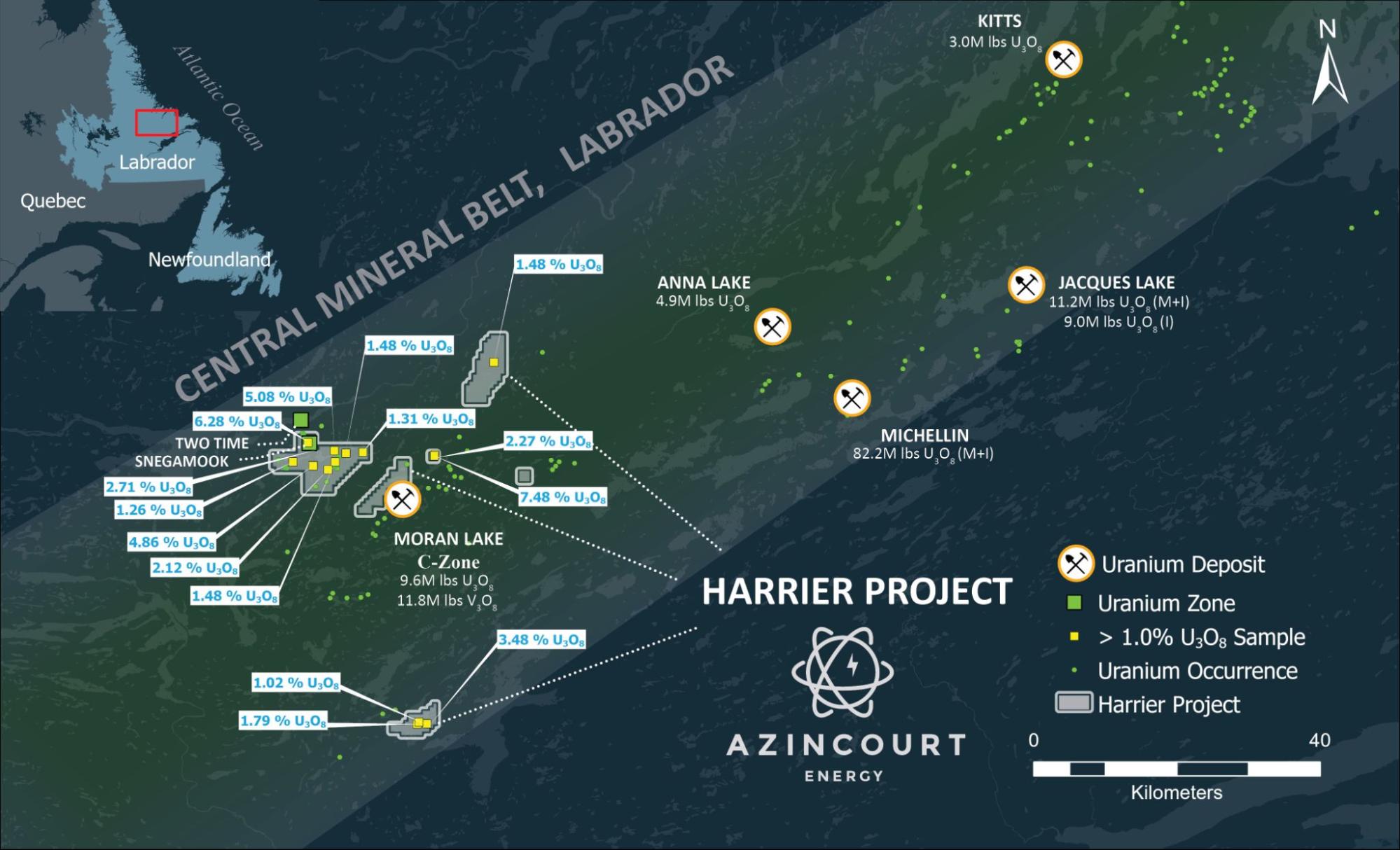
Zoom out from Snegamook and the Harrier Project reads like a menu of follow-up targets. Fourteen mineralized zones have been identified, with historical surface samples running as high as 7.48% U3O8 and ten separate zones sampling above 1%.39,40 For scale, the world’s average uranium mine grade is a small fraction of one percent, which is why numbers like these keep the company’s geologists coming back.
For Azincourt Energy Corp. (TSXV:AAZ) (OTCQB:AZURF), the zones read like a prospector’s wish list: Fish Hawk North up to 5.08% U3O8, Brook to 6.28%, Moran Heights to 7.48% in outcrop with a 7.2% boulder, and the Boiteau, Minisinakwa and Anomaly 7-17 areas running 1.3% to 5.5%.41
The company’s own boots-on-the-ground work keeps validating the belt. 2025 prospecting returned 6.28% U3O8 at the Brook showing, where earlier sampling had returned 4.86%, and 2.27% at Moran Heights along an 8-kilometre trend that runs toward ATHA’s Moran Lake deposit.42
This summer, Azincourt Energy Corp.‘s (TSXV:AAZ) (OTCQB:AZURF) reconnaissance added the Boiteau Lake area, Anomaly 7, and the Minisinakwa claims, where two boulders graded 1.02% and 1.79% U3O8 from a source no one has found yet.43 Every one of those is a discovery lottery ticket being worked toward drill-ready status.44
And every pound of it is being hunted in a market that one fuel-market executive described this bluntly:
Sylvia Lake: The Newest Piece, Added While Nobody Was Watching
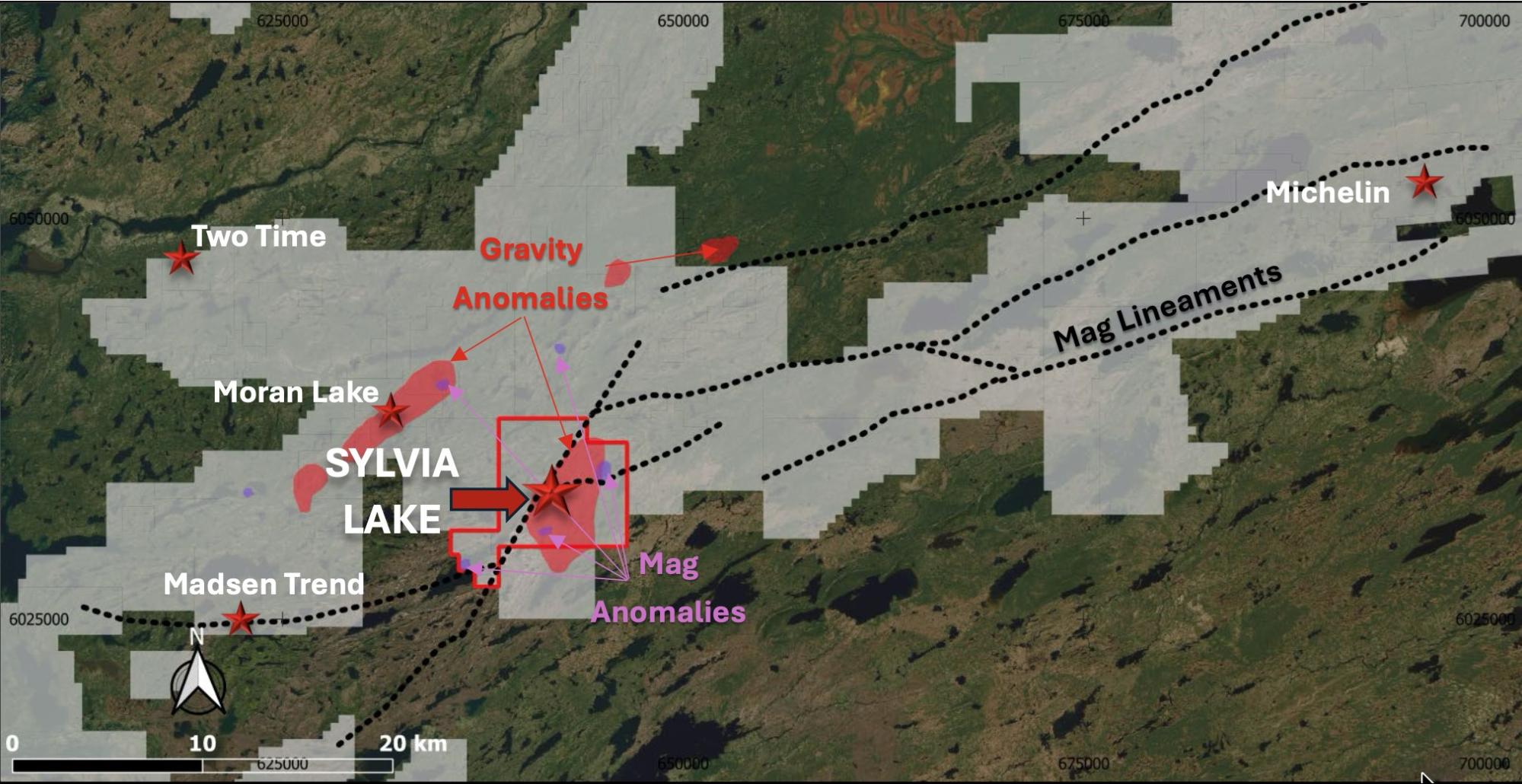
On August 4, Azincourt Energy Corp. (TSXV:AAZ) (OTCQB:AZURF) optioned a 100% interest in the Sylvia Lake Uranium Project, 6,725 hectares on the southern margin of the CMB, between the Michelin deposit and the Madsen trend, and updated the option terms on September 16.46,47 The TSX Venture Exchange has approved the option, and the company has completed the initial cash payment and share issuances.
Under the amended agreement the total consideration is modest: staged cash payments totalling $674,000 across the underlying owner and the optionor, 1.76 million shares, and $250,000 of exploration work over 24 months, subject to exchange approval. For a project with confirmed high-grade uranium at surface, those are option terms from a different era of the uranium market.48
What that buys is a known high-grade occurrence, not a guess. Historical grab samples at surface returned up to 2.72% U3O8, with additional results of 0.98% and 0.62%, and 2007 drilling intersected the mineralized horizon in every hole drilled.49 Grab samples are selective and may not represent the project as a whole, but the structural setting is Azincourt Energy Corp.‘s (TSXV:AAZ) (OTCQB:AZURF) thesis: the showing sits within about 300 metres of the intersection of multi-kilometre-scale structures, associated with a coherent gravity-high anomaly, and mineralization remains open along strike and at depth.50
Perkins’s read on the target is that structural intersections, flexures and dilation zones are where thickness and grade may increase, and the next phase of work is designed to vector into them.51 In practical terms, the company just added a second high-grade Labrador project, with drilling already proven to hit the horizon, for less than the cost of a single deep Athabasca hole.
The Uranium Math Keeps Getting Better
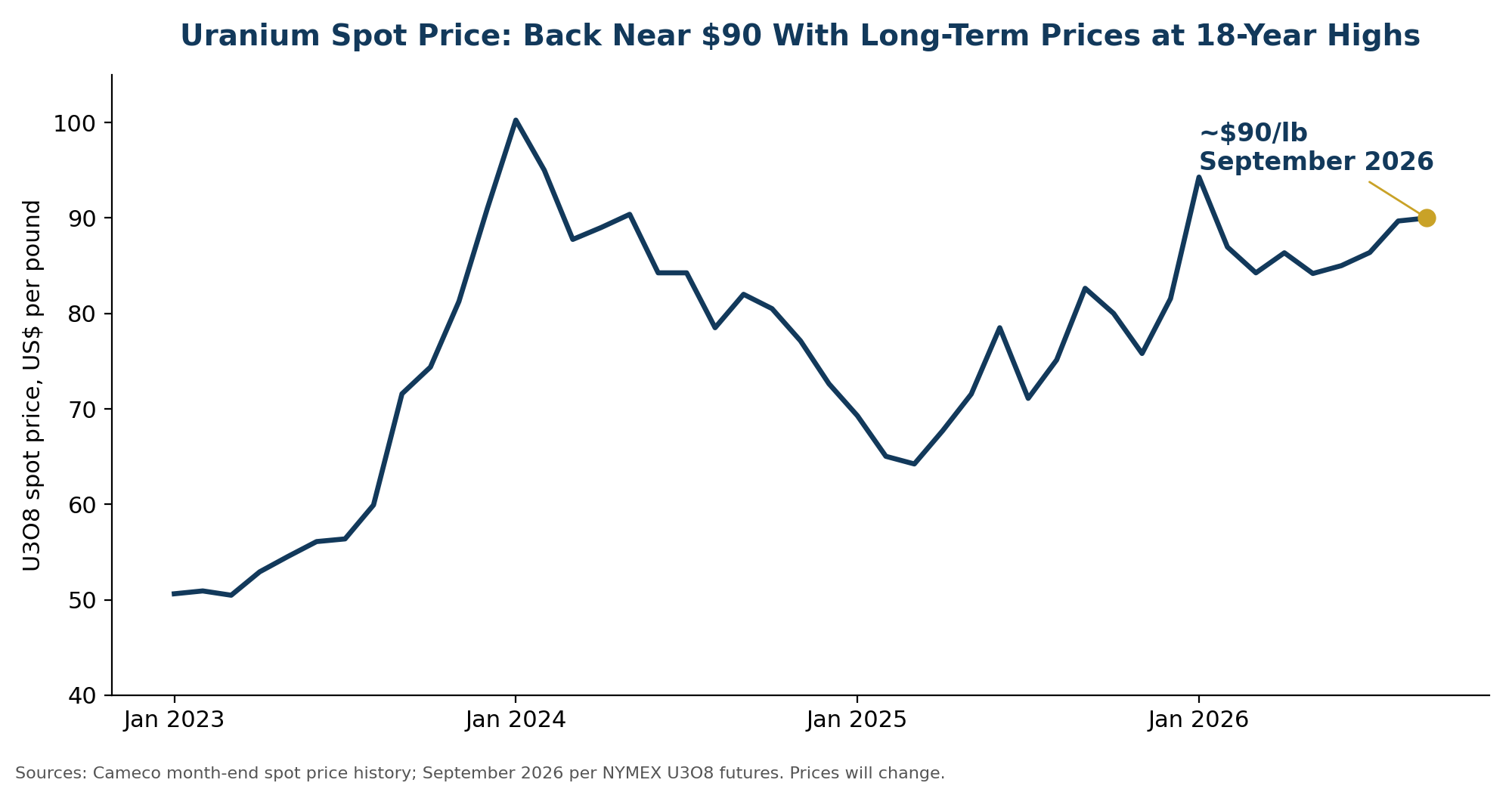
Uranium spot price by month. Sources: Cameco month-end price history; September 2026 per NYMEX futures
Step back to the commodity, because it is the tide under every boat in this sector. The IAEA now projects global nuclear capacity could triple by 2060, and 38 nations pledged at COP28 to triple capacity by 2050.52 One recent analysis projects the global uranium market, the one every Azincourt Energy Corp. (TSXV:AAZ) (OTCQB:AZURF) pound would be sold into, growing to $13.59 billion by 2033 with Washington itself becoming the sector’s largest counterparty.53
Utilities are moving too. After years of living off inventory, they are returning to the long-term contracting table, and physical uranium funds keep absorbing spot-market pounds, stabilizing the floor under the price.54,55 The question analysts now debate is not whether demand grows, but whether it more than doubles.56
And the AI bid is only starting to show up in the numbers. Thirteen reactor agreements from four technology giants, restarts moving from announcement to federal financing in under a year, and grid planners forecasting data centers as the fastest-growing power consumer of the decade: every one of those megawatts eventually becomes an annual uranium requirement, and the fuel cycle is already straining, with enrichment prices more than tripling in three years.57,58,59
Producers tend to feel the commodity backdrop first; for explorers like Azincourt Energy Corp. (TSXV:AAZ) (OTCQB:AZURF), the drill results are the next test.
Meanwhile supply keeps disappointing, which is the half of the equation the explorers are positioned for. The world’s largest producer has struggled with input shortages, utilities are returning to long-term contracting, and analysts describe demand that could more than double as the reactor pipeline builds out.60,61 Canada, the world’s second-largest producer, is the jurisdiction the West trusts to fill the gap, and the company holds ground in both of its premier uranium regions. As Western utilities work to reduce reliance on eastern supply chains, Canadian pounds carry a premium that has nothing to do with grade and everything to do with geopolitics.62
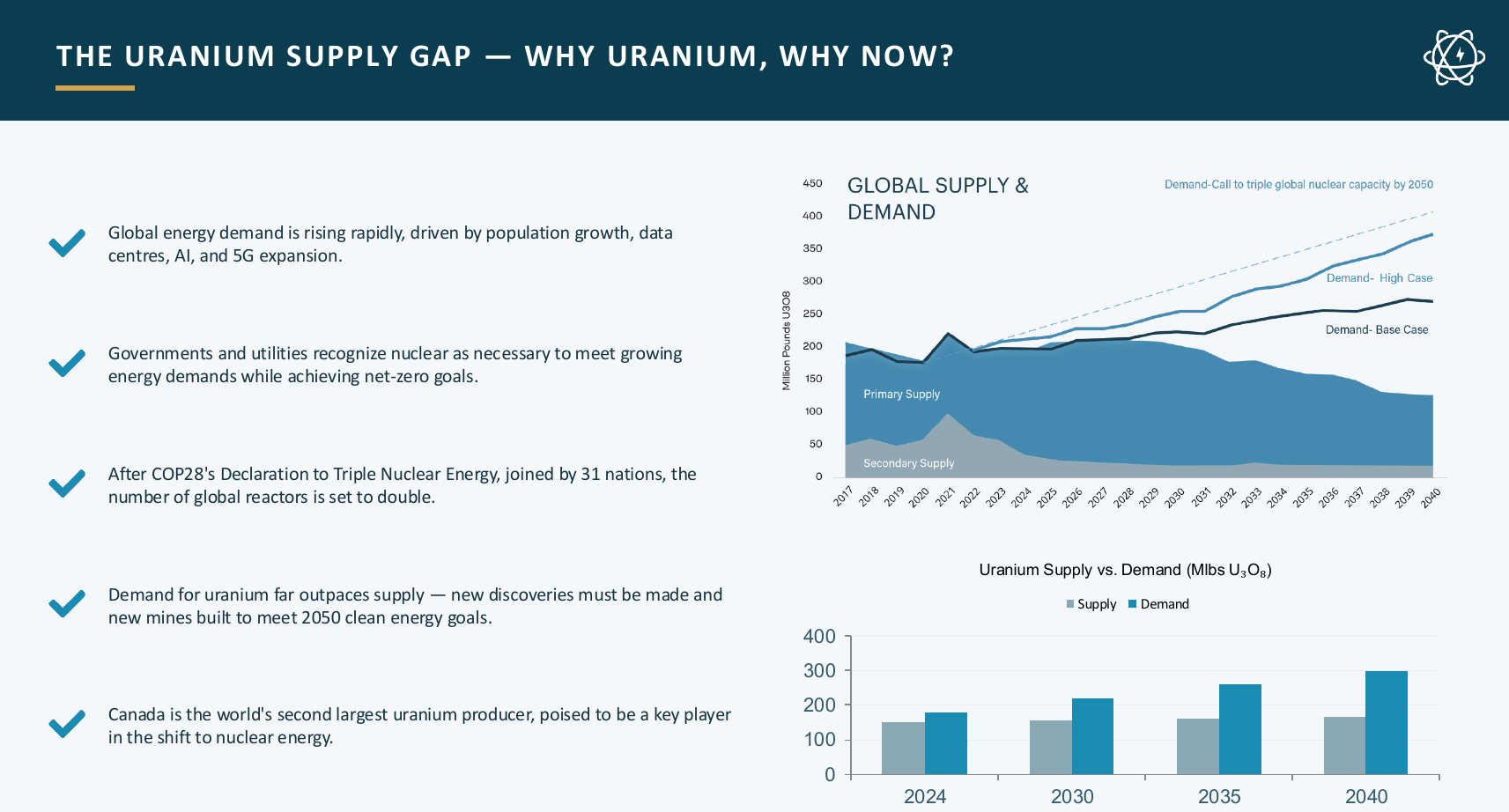
The uranium supply gap: demand rising toward the tripling goal while primary supply declines. Source: Azincourt Energy Corporate Presentation
The Athabasca piece deserves one paragraph of its own. East Preston is a 20,674-hectare project, roughly 87% owned, with more than $20 million spent to date, a 10-kilometre illite alteration system, key uranium pathfinder minerals and three prospective corridors, in a neighbourhood where nearby operators carry a combined market value above $20 billion.63
It is not the headline of Azincourt Energy Corp.‘s (TSXV:AAZ) (OTCQB:AZURF) story. It is the free option attached to it, and in a market where western Athabasca neighbours carry that kind of value, free options have a way of mattering. Airborne and ground geophysics, gravity and HLEM surveys, and 2021 to 2024 drilling confirmed elevated uranium, favourable basement lithologies and graphitic structures, the classic ingredients of basin-margin discoveries.
8 Reasons
AAZ Belongs on Your Watchlist Right Now
1
A drill is turning as you read this. Approximately 2,000 metres in 6 to 10 holes at Snegamook began in early September, with probe results expected in the coming weeks, with laboratory assays to follow.
2
A maiden resource is the stated goal. Core review, twin holes and an independent Qualified Person are all feeding Azincourt Energy Corp.’s (TSXV:AAZ) (OTCQB:AZURF) evaluation of a potential first NI 43-101 resource for Snegamook
3
Confirmed high grade, not hoped-for grade. A 2.71% U3O8 result from a 10 cm check sample within the best historical interval, 7.48% at surface, and ten zones above 1%.
4
The right neighbourhood. Adjacent to and on trend with deposits reported at 127.7, 9.3 and 4.9 million pounds, in a belt with three large landholders and Azincourt the only one still at the discovery stage.
5
Barely drilled ground. 124 holes ever, across approximately 13,000 hectares with fourteen known zones and untested radiometric anomalies.
6
A growing Labrador pipeline. Sylvia Lake adds 6,725 hectares of high-grade optionality for modest staged consideration.
7
Athabasca optionality on the side. East Preston: 20,674 hectares, $20 million of work, three corridors in the world’s highest-grade uranium district.
8
A commodity at the right point in its cycle. Spot near $90, long-term prices at a record nominal high and reactor deals stacking up faster than mines are being built. That is the market Azincourt Energy Corp. (TSXV:AAZ) (OTCQB:AZURF) is drilling into.
The Two People Driving the Program
 Mark TommasiPresident and CEO
 C. Trevor PerkinsP.Geo., Vice President, Exploration.
What to Watch Between Now and Winter
In the coming weeks: Probe results from the 2,000-metre Snegamook program, with laboratory assays to follow, plus prospecting results from Brook, Boiteau Lake, Anomaly 7 and Minisinakwa.67
After the drill program: Azincourt Energy Corp. (TSXV:AAZ) (OTCQB:AZURF) continued work toward a potential maiden NI 43-101 resource estimate for Snegamook. Timing will depend on how much is completed before the program wraps up and whether there is enough data.68
Near term: With exchange approval received and the initial Sylvia Lake payments and share issuances complete, the next step is first modern fieldwork there.69
Ongoing: Target development across the fourteen Harrier zones toward the next drill campaigns, and news from the CMB’s other landholders that keeps attention on the whole belt.70
Through it all: the uranium tape itself. With utilities contracting, physical funds absorbing supply and reactor deals compounding, the commodity backdrop is a catalyst of its own.71,72
The Bottom Line
The demand side of nuclear has never looked like this. Reactor restarts funded by billion-dollar federal loans, twenty-year power deals signed by the richest companies on earth, uranium near $90, long-term prices at a record high, and a supply pipeline that a decade of underinvestment left empty. Utilities know it, governments know it, and the deal tape says Google, Microsoft, Meta and Amazon have figured it out too.
Against that backdrop, Azincourt Energy Corp. (TSXV:AAZ) (OTCQB:AZURF) offers something scarce: a genuinely underexplored, high-grade uranium district position in a stable jurisdiction, with a drill already turning, a potential maiden resource it is working toward, large reported deposits on neighbouring trends, and a growing portfolio assembled at exploration-stage prices. Probe results are expected in the coming weeks, with laboratory assays to follow.
“Sylvia Lake provides that combination. It is located in Labrador’s Central Mineral Belt, a district with a demonstrated history of uranium discoveries, and gives the Company an opportunity to advance a project where high-grade surface mineralization, historical drilling and modern geophysical interpretation all support a compelling exploration thesis.” – Mark Tommasi, CEO, Azincourt Energy, August 4, 202673
Want to stay ahead of every Azincourt Energy (TSXV:AAZ) (OTCQB:AZURF) development as the Snegamook results come in and the company works toward a potential maiden resource?