The United States built its industrial dominance on access to the raw materials that power civilization.
The copper that wired its cities. The iron that built its bridges, buildings and railways. The materials that armed its military and launched its satellites.
America dug those materials out of its own ground, processed them on its own soil, and shipped them to the world.
Then it fell behind.
Today, the US depends on foreign sources, primarily China, for the majority of critical minerals essential to modern defense, energy, and advanced technology.1
The very materials used in F-35 fighter jets, electric vehicles, semiconductors, and grid-scale storage are now predominantly controlled by strategic adversaries.2
The consequences are impossible to ignore. Chinese dominance of rare earth processing, nickel refining, and cobalt supply chains has given Beijing strategic leverage over Western industry at a moment of historic geopolitical tension.
Washington is now making critical mineral security a national priority, deploying executive authority, taking direct government equity stakes, and mobilizing institutional capital to reverse decades of supply chain vulnerability.
The evidence is measurable:
The US government launched Project Vault, a $12 billion initiative to establish a domestic strategic critical minerals reserve.3
The Pentagon took a $400 million direct equity stake in MP Materials, becoming the largest shareholder in the only operational rare earth mine in the US.4
The US government took a 10% stake in Trilogy Metals, a Vancouver-based company with Alaskan mining interests,5 a 5% equity stake in Lithium Americas and its joint venture with General Motors,6 and backed $1.6 billion in funding for USA Rare Earth alone.7
The DFC joined a $1.8 billion consortium to secure critical mineral supply chains.8 JPMorganChase committed to a $1.5 trillion multi-year Security and Resiliency Initiative to finance industries critical to national economic security.9
Investors who have been paying attention have seen this movie before. It looks like the Bakken Shale. It looks like the Permian Basin. Faced with the risks of relying on OPEC for oil, the US unleashed a shale boom that drew massive waves of domestic capital into new production and sharply reduced its dependence on foreign barrels.10
We believe the same dynamic is now emerging in critical minerals.
With shifting policy, we see the beginning of a potential structural realignment of American industrial capital.
This company is built for this moment.
The Metals Royalty Company Inc. (TMCR) (NASDAQ:TMCR) is a financing provider targeting royalties, streams and structured interests to secure American mineral sovereignty. Its mission: Financing America’s Mineral Security. It has royalty exposure to what may be one of the most strategically important undeveloped nickel, copper, cobalt and manganese deposits on earth: TMC the metals company’s (TMC) (NASDAQ:TMC) NORI project.
The Business Model That Has Quietly Minted Fortunes for Decades
Before we get to the asset, we need to talk about the model. Because understanding why royalty companies exist, and why they consistently outperform, is the key to understanding The Metals Royalty Company Inc. (NASDAQ:TMCR).
Mining is a difficult business. Commodity prices can swing unpredictably. Operating costs can inflate. Capital expenditures can balloon. Projects can take longer and cost more than anyone projected. The history of the mining industry is littered with companies that had world-class assets and mediocre returns because they owned the wrong layer of the business.
Royalty and streaming companies found a better way.
Instead of owning the mine, they own a financial interest in the mine’s production. They provide upfront capital to operators in exchange for the right to receive a percentage of revenue, often for the life of the asset, with no ongoing capital commitments, no direct operating exposure, and no direct inflation risk.
Franco-Nevada (NYSE:FNV) paid roughly $2 million for a royalty on a modest heap-leach gold operation in the Carlin Trend back in 1986.
It did not build the mine. It did not manage the workforce. It did not absorb rising fuel, labor, or capital costs. It simply held its contractual right to a percentage of everything that came out of the ground.
That $2 million royalty eventually generated over $1 billion in revenue. Franco-Nevada used it as a platform asset and is now worth over $50 billion.11
Wheaton Precious Metals (NYSE:WPM) built a $70 billion company starting with a single silver streaming agreement. Royal Gold (NASDAQ:RGLD) anchored itself to the Cortez Pipeline Mining Complex in Nevada, which remains its cornerstone asset today.
The formula is proven. Get the model right. Anchor it to a world-class asset. Let time, scale, and scarcity do the heavy lifting.
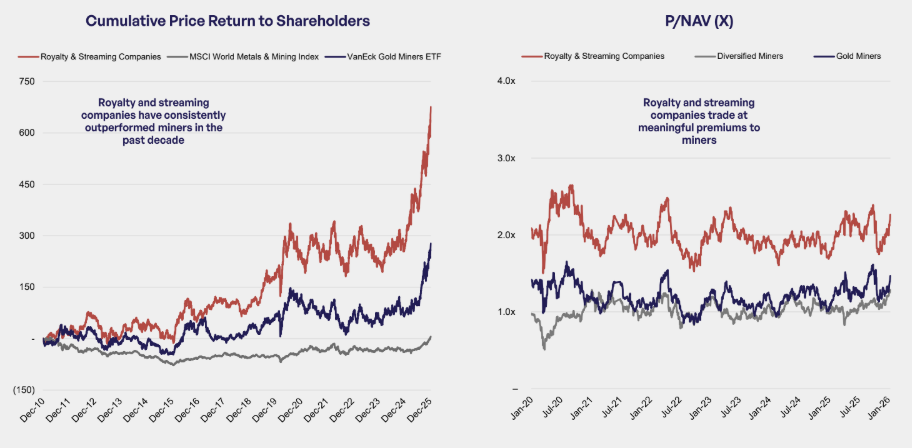
The royalty model commands a premium. Over the past decade, major royalty and streaming companies have delivered cumulative returns of more than 600%, while often trading at roughly 2x price-to-NAV compared to about 1x for diversified miners.
 And yet, for all the value this model has created – Franco-Nevada, Wheaton Precious Metals, and Royal Gold built their empires almost entirely on precious metals – nobody has applied it to critical minerals at scale.
That is white space The Metals Royalty Company Inc. (NASDAQ:TMCR) was built to occupy.
TMCR believes the category is open, the moment is now, and NORI is the platform asset to build off.
8 Reasons
The Metals Royalty Company (NASDAQ:TMCR) Deserves a Spot on Your Radar Right Now
1
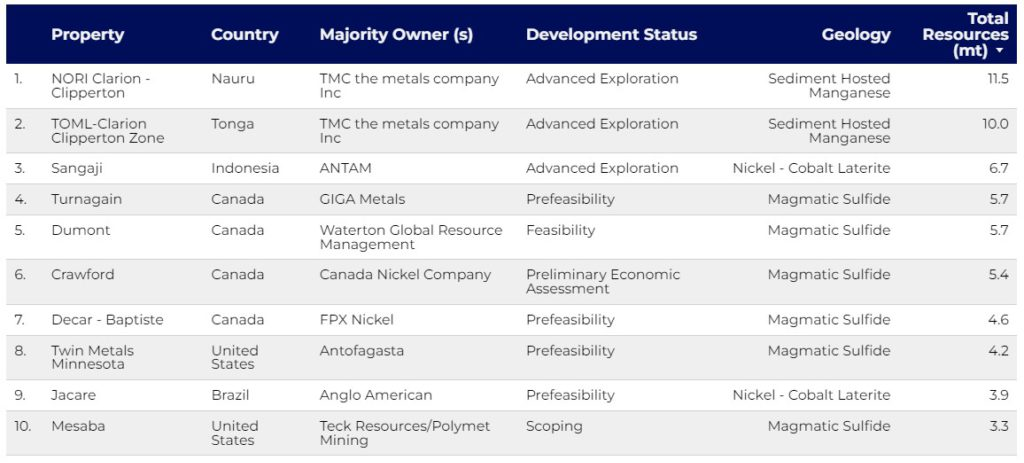
The Cornerstone Asset. Mining.com ranks the NORI concession as one of the world’s potentially largest undeveloped nickel-equivalent resources – a polymetallic deposit of nickel, copper, cobalt, and manganese that position it as a potentially generational supply asset.12 TMCR (NASDAQ:TMCR) holds a 2% royalty on all of it.
2
The GORR Structure: Paid on Top-Line Revenue, No Deductions. Most royalties are calculated after processing, refining, and cost deductions. TMCR (NASDAQ:TMCR) holds a gross overriding royalty, meaning it gets paid a fixed percentage of the top-line value of whatever is produced and sold. Simple, predictable.
3
Zero Capex. Zero Opex. Zero Inflation Exposure. The Metals Royalty Company Inc. (NASDAQ:TMCR) is not responsible for the construction or operation of the NORI project. If costs rise, TMCR’s royalty is unaffected by reduction in the operator’s net revenue. When production scales, TMCR’s revenue scales with the operator’s gross revenue. This provides full upside participation with zero direct cost exposure – the structural engine of every great royalty company.
4
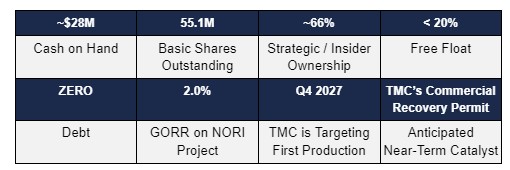
A Tight Structure Built for Maximum Shareholder Alignment. The Metals Royalty Company Inc. (NASDAQ:TMCR) has approximately 66% of shares held by founders, management, the Hess family, and TMC and a free float of approximately 20%. The people who built this vehicle overwhelmingly own it. This reduces potential misalignment between insiders and public shareholders.
5
A Business Model With a Decade of Demonstrated Outperformance. According to S&P Capital IQ and Bloomberg, the major royalty and streaming companies delivered cumulative returns of over 600% over the past decade. They trade around 2x P/NAV versus approximately 1x for miners. TMCR (NASDAQ:TMCR) applies the best compounding business model in the natural resources sector to a category where the established royalty majors are not yet entrenched.
6
The US Permitting Pathway is Now the Clearest it’s Ever Been. In January 2026, TMC USA filed the first consolidated deep-seabed mining application under the US Deep Seabed Hard Mineral Resources Act of 1980.13 On March 9, 2026, NOAA determined the application is in substantial compliance with DSHMRA.14 On May 1, 2026, NOAA issued a full compliance determination, advancing the application into the certification stage, with a final permit decision expected before the end of Q1 2027.15 The Metals Royalty Company’s (NASDAQ:TMCR) revenue potential increases with every step forward by TMC, with no additional capital deployed and no operational risk assumed by TMCR.
7
Permanent Capital, No Short-Term IRR Mandates. TMCR (NASDAQ:TMCR) was purpose-built without the constraints of short-term IRR mandates. It is designed as a permanent capital vehicle, able to finance assets across full commodity cycles and hold them through the decades-long production profiles that world-class mining assets require.
8
The NORI Royalty Is the Anchor, Not the Ceiling. The NORI royalty is the cornerstone of the portfolio – but The Metals Royalty Company Inc. (NASDAQ:TMCR) was built as a platform, not a single-asset vehicle. The mandate is to build a growing portfolio of royalties, streams, and structured interests across the full critical minerals value chain: from early exploration through production and mine expansion, across the nickel, copper, cobalt, manganese, and adjacent minerals that define America’s mineral security challenge.
Press Releases
- The Metals Royalty Company to Host Corporate Update Webinar on May 13, 2026
- The Metals Royalty Company Inc. Enters Into Definitive Agreement to Acquire a Royalty Interest on Mesabi Metallics Iron Ore Project in Minnesota
- The Metals Royalty Company Inc. Announces Anticipated Commencement of Trading on the Nasdaq Capital Market
- The Metals Royalty Company to Host Corporate Webinar on March 16, 2026 Ahead of Planned Nasdaq Direct Listing
- The Metals Royalty Company Inc. Announces Public Filing of Registration Statement for Proposed Direct Listing of Its Common Shares
What The Metals Royalty Company Actually Is
The Metals Royalty Company Inc. (NASDAQ:TMCR) is a financing provider for the onshoring and near-shoring of US critical minerals and industry. Its mission is clear: Financing America’s Mineral Security.
TMCR’s business is designed to deliver commodity and asset upside without direct exposure to development capital costs, operating expense inflation, or the execution risk that comes with operating a mine. It deploys capital across the long arc of critical minerals development, aligning with the multi-decade horizons these assets require.
The portfolio is anchored by NORI, but The Metals Royalty Company Inc. (NASDAQ:TMCR) was not built to remain a one-royalty story.
The vision is to build a growing portfolio of royalties, streams, and structured interests across the full critical minerals value chain – from early exploration through production and mine expansion – turning one highly strategic cornerstone asset into a broader financing platform to fortify America’s mineral security and re-industrialization.
That is why we believe TMCR’s business model is compelling. It has the potential to be an early critical mineral royalty platform designed to grow, diversify, and compound over time.
The Metals Royalty Company Inc. (NASDAQ:TMCR) was purpose-built by a team with a proven track record of deploying capital into resource assets, creating shareholder value, and is anchored by one of America’s most recognized industrial families.
The Hess family, the American energy dynasty that sold Hess Corporation to Chevron for $55 billion16 in one of the largest energy transactions in recent history, holds a cornerstone position in The Metals Royalty Company Inc. (NASDAQ:TMCR).
Michael Hess, Chief Investment Officer of Hess Capital, serves as Strategic Advisor. His relationships across the American investment, policy, and industrial landscape are central to TMCR‘s positioning as the preferred financing partner for US-focused critical mineral development.
The Hess family has been here before. They built one of the great American energy companies from the ground up, navigated commodity cycles, and sold at a moment of significant value. That institutional knowledge – of how to build, finance, and realize value in resource businesses – is now focusing on critical minerals.
The capitalization structure reflects the conviction of everyone at the table.
55.1 million basic shares outstanding. ~$28 million in cash. Zero debt. 66% insider and strategic ownership. A free float of less than ~20%.
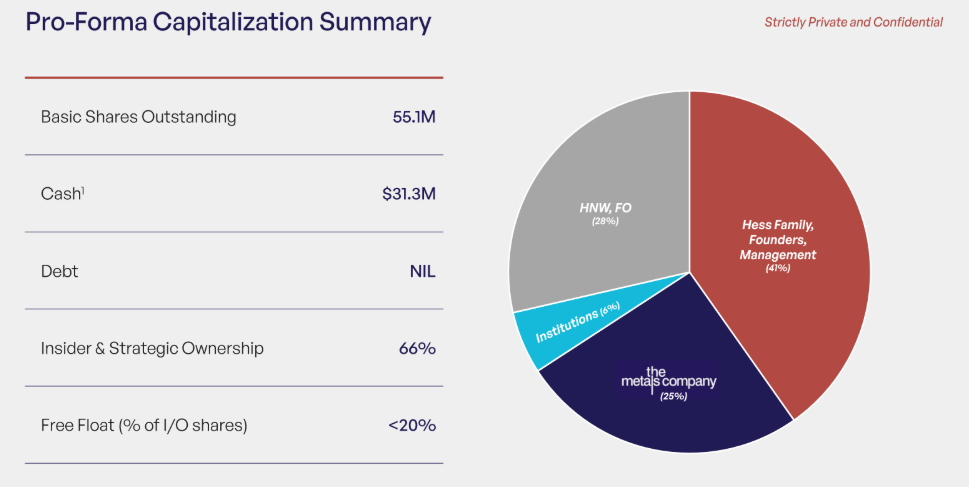
When two-thirds of a company is held by one of America’s most consequential industrial families, its founders, management, and a NASDAQ-listed industry leading strategic partner (TMC), the alignment between insiders and new shareholders is strong.
There are no large blocks looking for the exit yet. There is no overwhelming overhang from an early-stage financing that diluted the cap table.
The portfolio is anchored by a 2.0% gross overriding royalty (GORR) on TMC the metals company’s (NASDAQ:TMC) NORI project, ranked by Mining.com as one of the world’s potentially largest undeveloped nickel-equivalent resources.17
The NORI Royalty, One of the Potentially Most Consequential Financial Instruments in Critical Minerals
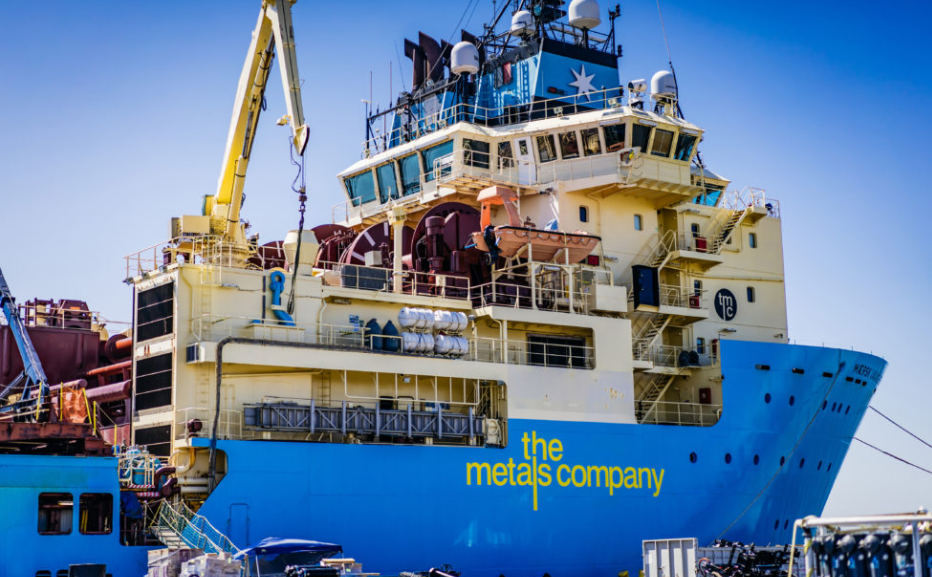
Let us explore the scale of what may sit beneath this royalty and the work that has been done to unlock it.
The NORI project is the centerpiece of one of the most closely watched critical minerals stories in the market today.
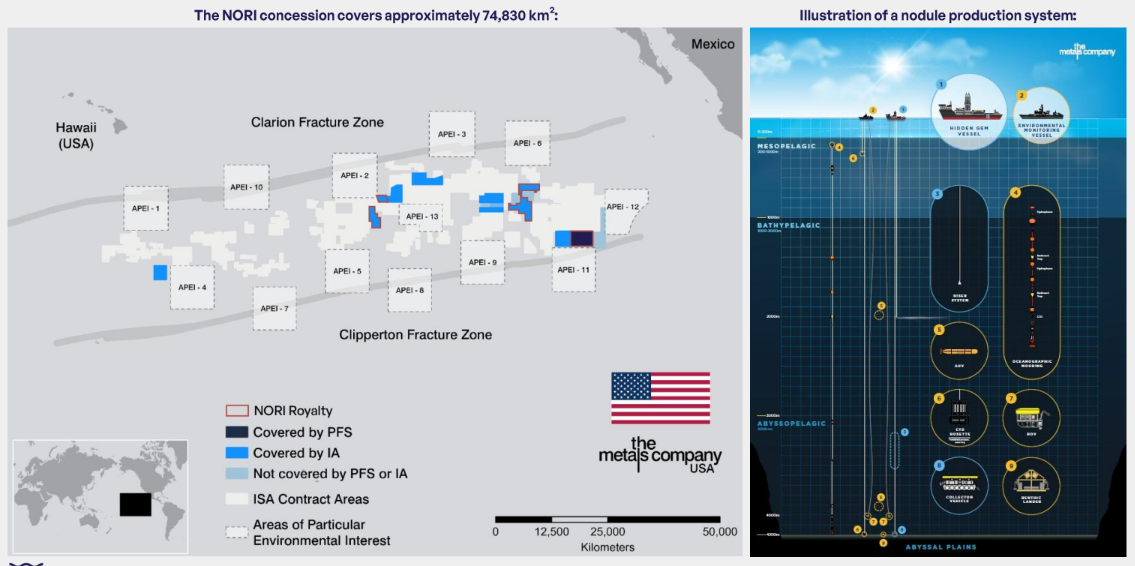
NORI is located in the Clarion-Clipperton Zone, a stretch of Pacific Ocean seabed between Hawaii and Mexico that may host one of the most concentrated collections of critical minerals on the planet.
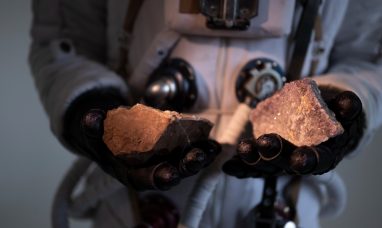
The abyssal plain across this region contains potato-sized polymetallic nodules, mineral formations that have been accumulating on the seafloor for millions of years and naturally concentrating the exact metals advanced economies need most: nickel, copper, cobalt, and manganese.
These are four of the most important inputs for EV batteries, grid storage, and defense applications. They are rarely found together in one place. At NORI, they occur within each nodule.
The scale of the resource is not in question. Mining.com has ranked NORI among the potentially largest undeveloped nickel-equivalent resources on the planet.18
TMC the metals company Inc. (NASDAQ:TMC) has already spent 15 years and over $700 million moving NORI from concept toward commercial reality.19 This is not a theory-stage project.
The project has been tested, advanced, and de-risked across the scientific, technical, operational, and regulatory fronts.
That work includes 23 offshore research campaigns conducted with more than 20 global deep-sea research institutions, as well as the first integrated nodule collection test since the 1970s.
In 2022, TMC and Allseas successfully lifted more than 3,000 tonnes of nodules from the seafloor, proving the collection system works in real-world conditions. Processing and refining work has also been completed at pilot and bench scale, producing targeted product formats through an established network of partners.
And unlike conventional mining, there is no blasting, no tunneling, and no underground development.
The commercial validation is also compelling.
Korea Zinc, one of the world’s largest metals processors, invested $85.2 million and became TMC’s processing and refining partner alongside PAMCO.
Allseas, one of the leading offshore construction companies in the world, helped demonstrate the collection technology at sea and is TMC’s offshore partner and second largest shareholder.
Glencore has signed an offtake agreement covering 50% of expected nickel and copper production, plus a letter of intent covering 100% of manganese production.
That kind of partner roster matters. Capital and counterparties of this caliber do not commit to speculation. They typically show up when they believe the asset is real, the engineering is workable, and the path forward is credible.
The Metals Royalty Company Inc. (NASDAQ:TMCR) holds a 2.0% gross overriding royalty on all metals and minerals produced and sold from the NORI areas.20 No capital commitment to the project. No operating obligation to the project. A contractual right to a percentage of gross revenue from product sold from the first day of production, for the life of the project.
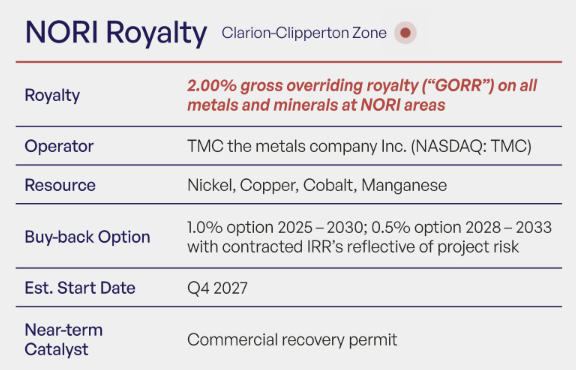
Every campaign TMC runs, every regulatory milestone it clears, every strategic partner it brings on board increases the probability and proximity of that royalty paying. The Metals Royalty Company Inc. (NASDAQ:TMCR) holds the right to be paid when production starts to generate revenue.
The Washington Tailwind, Why the Permitting Runway Has Never Been Clearer
The policy environment behind this project has shifted decisively – and it shows no sign of reversing during this administration.
In April 2025, President Trump signed an executive order directing federal agencies to accelerate the development of America’s offshore and deep-sea critical mineral resources, explicitly citing national security and the need to reduce dependence on China.21 The order called for streamlined permitting, expanded ocean mapping, and stronger domestic processing capacity.
NOAA responded by accelerating its permitting timeline under the Deep Seabed Hard Mineral Resources Act of 1980, giving TMC USA a US pathway to commercial recovery that does not rely on the United Nation’s International Seabed Authority process.
That independence matters. It means the NORI permitting pathway is not subject to the multilateral delays and political dynamics that have stalled other deep-sea projects globally.
In January 2026, TMC USA filed the first consolidated deep-seabed mining application under that framework, placing NORI at the front of the only regulatory pathway currently moving toward potential commercial approval.22
On March 9, 2026, NOAA determined the application is in substantial compliance with DSHMRA, advancing it into full technical and environmental review.23
On May 1, 2026, NOAA issued a full compliance determination, advancing the application into the certification stage, with a final permit decision expected before the end of Q1 2027.24
We believe that is the single most significant regulatory milestone in the history of this project because the process is finally moving.
The Metals Royalty Company Inc. (NASDAQ:TMCR) is an indirect financial beneficiary of every step forward in that process. No additional investment is required by TMCR. They hold an existing royalty agreement that becomes potentially more valuable with every regulatory milestone.
The policy tailwinds mean that NORI deposit is not just a financial opportunity for TMC. Unlocking the NORI deposit may be part of the solution to a genuine national security problem.
A Defining Acquisition: The Mesabi Metallics Royalty
On May 6, 2026, The Metals Royalty Company Inc. (NASDAQ:TMCR) announced it has entered into a definitive agreement to acquire a 1.0% Index-Priced Gross Overriding Production Royalty on Mesabi Metallics iron ore project in Minnesota – one of the United States’ few large-scale merchant DR-grade iron ore projects – for $132.5 million.
Transaction Highlights:
- $132.5 million cornerstone royalty acquisition – The Metals Royalty Company Inc. (NASDAQ:TMCR) has entered into a definitive agreement to acquire a 1.0% Index-Priced Gross Overriding Production Royalty with a Revenue Floor (on production up to 8.5 Mtpa) on the Mesabi Metallics iron ore project in Minnesota, anticipated to be a fully integrated, large-scale source of high‑quality DR‑grade pellets critical to the global green steel transition and the advancement of American domestic steel production.
- Financing funds acquisition – Transaction financed via allocated $75 million PIPE, including $15 million of participation from founders and insiders, priced at $13.00 per share; and up to a $50 million acquisition credit facility term sheet for a senior secured term-loan credit facility.
- Near-term, high-quality royalty cash flow – First production targeted for H2 2026 with ramp up to full capacity expected in 2027, implying anticipated initial annual royalty cash flow potential of up to ~$13M+ with further potential upside tied to commodity prices and throughput expansion.
- Tier-1 asset in a Tier-1 jurisdiction – The Mesabi Project spans more than 16,000 acres in Nashwauk, Minnesota and is expected to be one of the lowest‑cost DR pellet producers in North America, supported by a 23+ year mine life. Over $2.5 billion is planned to be invested by completion date in core infrastructure at the project, which is approximately 93% complete. The project is strategically positioned near key end markets and integrated into well‑established North American transportation networks.
- Essar Group sponsorship with proven execution – Backed by Essar Group, a global industrial platform with >50 years of experience, ~$15B of revenue, and a track record of building and operating world-class industrial projects including pellet and steel assets – providing TMCR with the sponsor quality and execution certainty that underpins a royalty investment of this nature.
- Project fully financed based on current expenditure budget to first cash flow – ~$2bn equity invested by Essar Group with additional support by a $520M senior secured facility from Breakwall Capital and a $150M liquidity line from Macquarie Group materially de-risking near-term path to production.
- Strong US Government validation and strategic relevance – US Export-Import Bank announced support of up to $10B, confirming Mesabi as a strategic national supply chain asset for American green steel.
- Strategic alignment – Advances TMCR‘s mission of financing America’s mineral security by deploying long-term permanent capital into a strategically critical domestic supply chain asset, aligned with US industrial and defense policy, supporting the development of domestic iron ore production capacity.
The Team That Built This and the Relationships That Make It Matter
The royalty model is a proven business. But the quality of any royalty company ultimately comes down to the people who identify the assets, structure the agreements, deploy the capital, and build the platform.
At The Metals Royalty Company Inc. (NASDAQ:TMCR), the three names that matter most are Brian Paes-Braga, Gerard Barron, and Michael Hess.
 Brian Paes-BragaChairman & CEO
 Gerard BarronDirector (Non-Executive)
 Michael HessStrategic Advisor
Who Holds Two-Thirds of the Company and Why it Matters
The people above are not advisors at arm’s length. They have put capital, reputation, and career behind this company. The ownership structure reflects that.
The Hess family holds a cornerstone position. They understand commodity cycles, long-duration assets, and what it means to build and hold through the arc of a resource business. They are not here for a trade.
TMC the metals company (NASDAQ:TMC) holds a 25% strategic stake in the royalty on its own flagship project. TMC’s commercial interest is in reaching production as efficiently as possible – and its financial interest in the royalty means every step forward increases the value of its own position. The operator and the royalty holder are partners, structurally and financially, interested in the same outcome.
The result is a capitalization structure unlike almost anything else in the newly listed small-cap space.
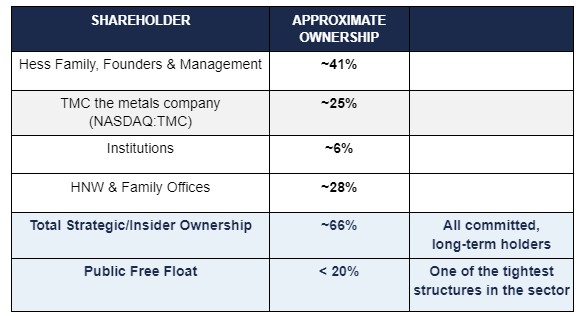
The strategic and insider ownership group are not speculators chasing a headline. These are founders, one of America’s great industrial families, and the NASDAQ-listed operator of the underlying asset – all with full access to the data, the roadmap, and the regulatory pipeline. They have structured their ownership to stay.
The free float is under ~20%. The insiders are committed. The operator of the cornerstone asset is a significant shareholder. We believe that combination, in a newly listed company, in potentially the most consequential resource category of the decade, is rare.
The Catalyst Stack Is Building. Here Is What Comes Next.
The near-term path from here to value creation for The Metals Royalty Company Inc. (NASDAQ:TMCR) is visible and sequenced:
- March 2026 – NOAA substantial compliance determination – achieved. May 2026 – NOAA full compliance determination – achieved. The application now moves into the certification stage, with a draft Environmental Impact Statement to follow.26
- NOAA commercial recovery permit – every regulatory milestone between now and that decision narrows the remaining risk and raises the fair value of the GORR.
- Portfolio expansion – TMCR enters the public markets with a clean balance sheet, a tight share structure, and a macro environment that is moving decisively in its direction. It has meaningful work ahead – building the royalty portfolio, deploying capital into the next generation of critical mineral projects, and supporting the onshoring of American mineral security. That work begins now.
- TMC targeting first production in Q4 2027 – converting permit to cash flow, with no additional capital deployed by TMCR and no operational risk assumed by TMCR.
As NORI advances through its regulatory pathway and TMCR seeks to deploy capital into additional royalties, the two engines of potential value creation for this company are running simultaneously and in the same direction.
The Bottom Line
America is in the early innings of potentially the most consequential industrial mobilization since World War II.
The critical minerals that power its defense, energy, and technology sectors are largely controlled by strategic adversaries. Washington has recognized this with unusual bipartisan clarity. The capital to fix it is now flowing, through executive orders, government equity stakes, institutional initiatives, and regulatory acceleration, at a scale that is redefining an entire sector.
Investors who understood the shale revolution before the market priced it in generated extraordinary returns. The investors who understood the rare earth supply chain problem before Washington made it a national priority generated extraordinary returns.
The Metals Royalty Company Inc. (NASDAQ:TMCR) was built for this exact moment in critical minerals. It holds a publicly traded royalty interest in what may be one of the world’s largest undeveloped polymetallic resources. It is structured with zero debt, a tight share count, and ~66% strategic insider ownership. It uses a battle-tested business model, and it applies that model to what may be the most consequential resource category of the next decade.
Want to stay ahead of The Metals Royalty Company (NASDAQ:TMCR) developments?
Subscribe to the Trading Whisperer Newsletter to review the corporate presentation and stay ahead of every development as TMCR starts its next phase as a public company.